



2023 CTSA Fall Program Annual Meeting Poster Spotlight: Sophia Kwon, M.P.H., D.O.
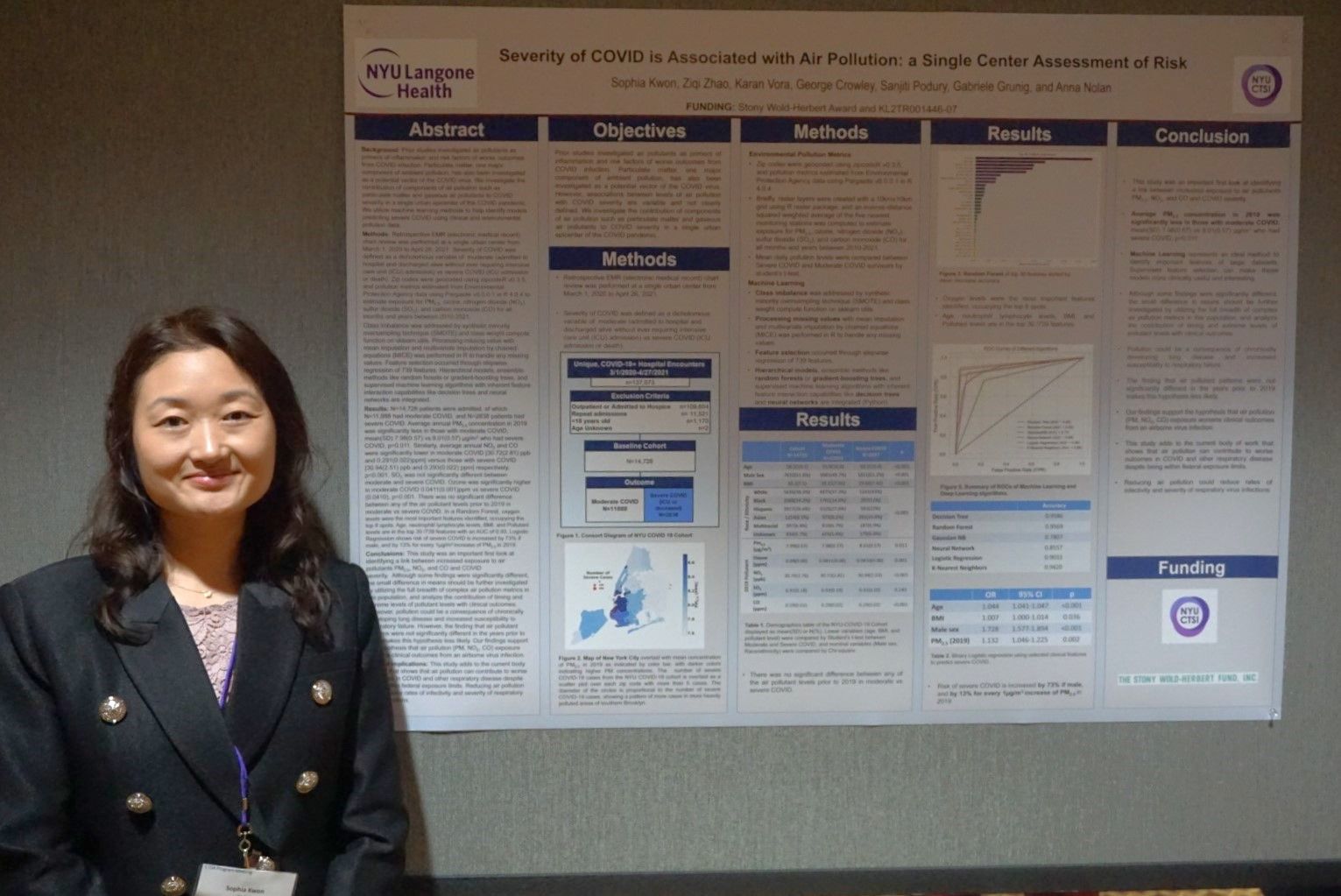
The CCOS Communications Team interviewed researchers at the 2023 CTSA Fall Program Annual Meeting poster session in November as part of a series to feature ongoing projects across the CTSA hubs. In this article, we’re featuring Dr. Sophia Kwon, KL2/K12 at New York University School of Medicine who presented her work on how the severity of COVID is associated with air pollution.
Research Question
Air pollutants have been investigated as primers of inflammation and risk factors of worse outcomes from SARS-CoV-2 (COVID-19) infection. In addition, particulate matter, a major component of air pollution, has been investigated as a vector of the COVID-19 virus. As such, Dr. Kwon and her team used machine learning methods to help investigate the contribution of components of air pollution (e.g. particulate matter, gaseous air pollutants) to COVID-19 severity in a single urban epicenter of the COVID-19 pandemic.
Research Plan
The team utilized machine learning methods to help identify models predicting severe COVID-19 infection using clinical and environmental pollution data. Retrospective electronic medical record data from March 2020 to April 2021 was parsed and COVID-19 infections were defined as moderate (admitted to hospital and discharged alive, no ICU admission) versus severe (ICU admission or death). Pollution metrics from Environmental Protection Agency data were estimated by patient zip code and included exposure to PM2.5, ozone, nitrogen dioxide, sulfur dioxide, and carbon monoxide during the study period.
The researchers found that the average annual PM2.5, nitrogen dioxide, and carbon monoxide concentrations were significantly lower in 2019 in those with moderate COVID-19 infections versus those with severe infections. Sulfur dioxide was found to have no difference in concentration between the populations, and ozone was found to be significantly higher in those with moderate infections when compared to those with severe infections.
Next Steps
The findings from this study support the hypothesis that air pollution exposure worsens clinical outcomes from an airborne viral infection. Reduction in air pollution concentrations could reduce the rates of infectivity and severity of respiratory viral infections.
Reflection with the Researcher: What do you want the general public to know about the work you’re presenting here tonight?
“This has been a wakeup call,” Dr. Kwon says of her research. “I want the public to know about the link we discovered between pollution and infectious diseases, and how that leads to worse health outcomes. We should be investing more in research to prevent these outcomes, given the patterns we’re seeing in climate change.”


