



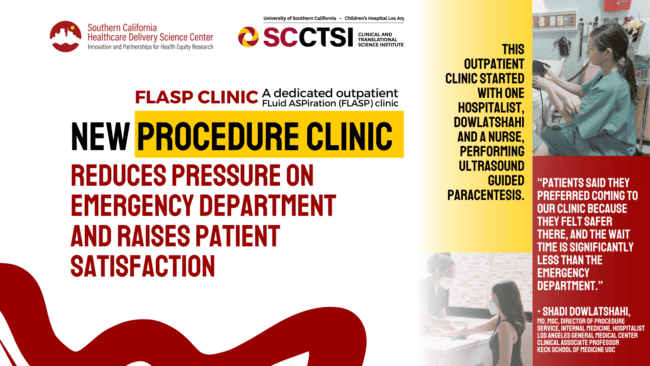
New Procedure Clinic Reduces Pressure on Emergency Department and Raises Patient Satisfaction
Cirrhosis of the liver has risen 1.5 to 2 times in the past two decades in the U.S with over 56,000 deaths annually. Among the serious complications of cirrhosis is the painful accumulation of large amounts of fluid in the abdomen, called ascites. Ascites can be relieved by paracentesis, a procedure that drains some of this fluid from the abdomen, but the fluid reaccumulates rapidly. Other more permanent options for management of ascites include the transjugular intrahepatic portosystemic shunt (TIPS) procedure for portal hypertension and liver transplantation. However, low-income communities face significant challenges to receipt of these interventions.
Consequently, low-income patients frequently rely on emergency departments to perform paracenteses—but the repeated need for this procedure burdens clinicians, staff, and the patients themselves, who can wait many hours for this care. Public health crises force the development of an innovative alternative for this care to allow emergency departments to meet the greatly increased demand for urgent care.
“During the COVID pandemic, patients repeatedly returning for paracentesis became a severe challenge for Los Angeles General Hospital, which is a large safety-net hospital serving a predominately low-income Latino population,” said Barbara J. Turner, M.D., M.S.Ed., M.A., M.A.C.P., Professor of Clinical Medicine at Keck School of Medicine of USC. Turner is the lead author of a study recently published in the Journal of General Internal Medicine...
Read the full article here.


