



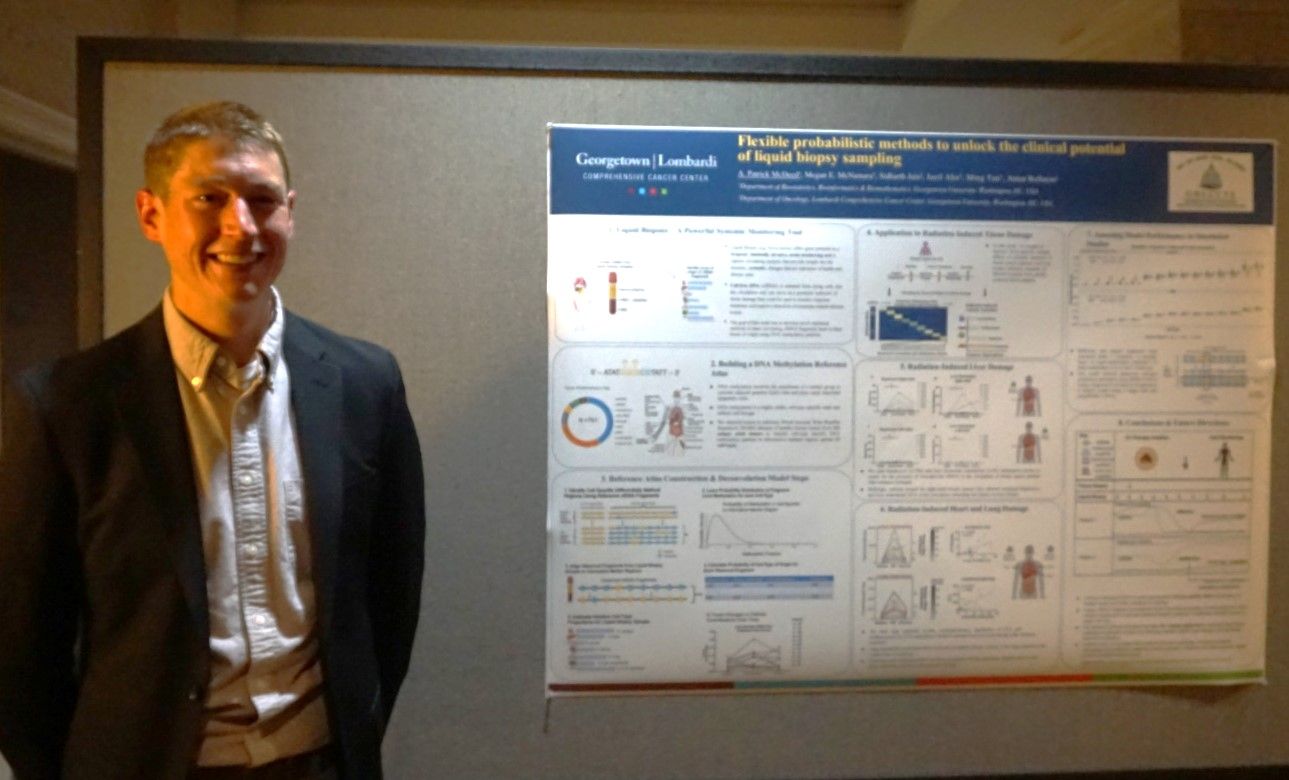
2023 CTSA Fall Program Annual Meeting Poster Spotlight: Patrick McDeed, M.S.
The CCOS Communications Team interviewed researchers at the 2023 CTSA Fall Program Annual Meeting poster session in November as part of a series to feature ongoing projects across the CTSA hubs. In this article, we’re featuring Patrick McDeed, pre-doctoral TL1 scholar at Georgetown-Howard Universities Center for Clinical and Translational Science who presented his work on flexible probabilistic methods to unlock the clinical potential of liquid biopsy sampling.
Research Question
Understanding the origins of cell-free DNA (cfDNA), released during cell death, in a liquid biopsy sample can give insight into changes that are reflective of the health and disease state of an organism. As such, cfDNA is an ideal target to monitor disease-related changes on the genomic level. However, current statistical models to trace DNA fragments back to their tissue of origin using DNA methylation patterns present unique statistical challenges. As such, Patrick and his team aimed to develop a novel statistical method to decode cellular origins of cfDNA fragments in liquid biopsies.
Research Plan
In this study, Patrick and his team used an Expectation-Maximization algorithm. This flexible and probabilistic method leverages co-regulation of neighboring CpG sites on an individual sequencing read to facilitate tissue of origin analysis. This differs from previous methods that focused solely on the methylation rates of single CpG sites. The team first tested their model's performance in simulated settings and then applied it to the clinical environment where it detected significant off-target tissue damage (in cardiac and lung tissue) from radiation therapy via minimally invasive blood draws in breast cancer patients.
The model captured the range of plausible methylation patterns on cfDNA read fragments more effectively than previous models and is robust to high levels of noise inherent with this type of data analysis.
Next Steps
The statistical methods developed by Patrick and his team have far-reaching applications. In the future, Patrick aims to apply these methods to serial monitoring of melanoma patients undergoing immunotherapy treatment. The team wants to assess the response to treatment and detect systemic signals of immune-related adverse events to improve patient outcomes.
Reflection with the Researcher: Were there any collaborative efforts that made this work possible?
Patrick is a biostatistician, so he relies heavily on collaboration with lab scientists, basic scientists, and physician scientists to help formulate interesting questions. In turn, they look to him to help define the best research methodologies for a given project. Patrick acknowledged that this collaboration is necessary for the success of his project.


