


Why Don't Pain Treatments Work? Naomi Carter Hopes to Find Out
Summary
Article
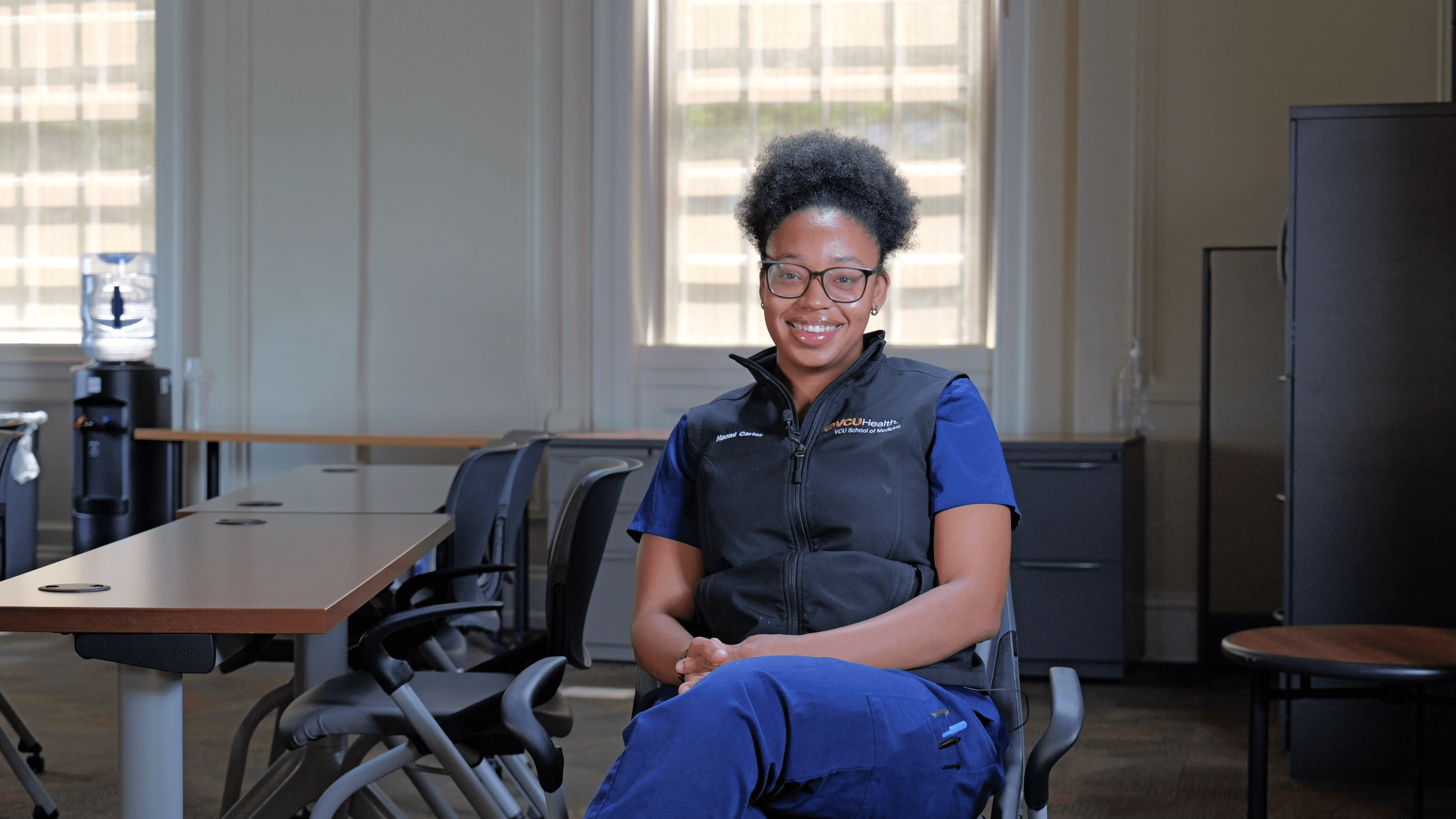
Naomi Carter has a mission, and she'll tell you exactly what it is.
"My mission is to improve how we treat patients. That is why I wake up every day. It's why I work hard. It's why I mentor. It's why I teach."
Carter is a fourth-year M.D.-Ph.D. student in the Medical Scientist Training Program at Virginia Commonwealth University's School of Medicine and a scholar in the Wright Center's Translational Biomedical Sciences T32 Training Program, a fellowship designed to deepen training in translational science and community-engaged research alongside doctoral work.
"Translational science is when you're trying to go from the bench — research in a lab — to research in humans that is helpful to people," she said. "And there are a lot of little barriers that exist between these two mediums."
Her own research targets one of those barriers directly.
"About 25% of Americans have chronic pain," she said. "That is a huge number." Despite decades of research and billions of dollars in federal funding, less than 1% of clinical trials testing drugs to treat chronic pain succeed. Carter wants to know why.
"My research is looking at the bumps and barriers and walls between our preclinical research and our clinical research in humans and asking the question, how can we knock those down?" she said. "So that next time when something works preclinically, it actually does work in people."
Her work is particularly focused on interstitial cystitis, also known as chronic bladder pain syndrome — a condition affecting roughly 10% of women for which no new therapy has been approved since 1996. "That is before I was born," Carter noted. "So we have a lot of work to do."
From the ambulance to the lab
Carter's path to research started in the back of an ambulance.
Growing up in Maryland with a pediatrician mother, she was drawn to medicine early. But becoming an EMT in high school first put her face-to-face with what would become her life's work.
"When patients call 9-1-1, when they call an ambulance, they are likely having their worst day. The ability to work with them and help take care of those patients was an honor and something that I found really fulfilling." But after dropping patients off, she said, "that was the end of patient care, and I found that frustrating. I wanted to provide extended treatment and continue working with patients."
That frustration led her to Hampton University, a historically Black university she describes as "a phenomenal experience," where her freshman biology professor convinced her to explore the MARC program, an NIH-funded initiative aimed at getting students from minority backgrounds into Ph.D. and M.D.-Ph.D. programs.
"After many, many no’s, she convinced me to go to one of the program meetings. I got intrigued with research, and I started to get a feel for how that could impact my career and impact the people I want to treat." Starting to do research, even in her freshman year, she was hooked.
“I just fell in love with it,” she said.
"I remember walking on campus and thinking, I really like research and I really like medicine. And I think the best thing for me to do is to do both."
Working with mentors
At VCU, Carter works with two mentors: S. Stevens Negus, Ph.D., a professor in the Department of Pharmacology and Toxicology in the VCU School of Medicine whose lab specializes in behavioral pharmacology and opioid research; and Julie Suyama, M.D., Ph.D., a urogynecologist in the Department of Obstetrics and Gynecology in the VCU School of Medicine, with deep expertise in interstitial cystitis.
"Together I have an excellent team of people who can support me in my work, which is to conduct preclinical research and clinical research on pain assessments in preclinical models of and patients with interstitial cystitis," Carter said. "Dr. Negus provides expertise on how we can assess pain preclinically, and Dr. Suyama provides the expertise on how to assess pain in patients."
Securing independent research funding
The T32 is designed to do more than pay a stipend. It requires trainees to develop and submit an extramural grant for their dissertation research and provides students with internal feedback on their grant before it goes to the NIH. "They'll review that grant and provide you with feedback before you submit it," Carter said.
This summer, Carter was awarded an NIH Ruth L. Kirschstein F30 predoctoral fellowship from the National Institute of Diabetes and Digestive and Kidney Diseases. The F30 fellowship, a highly competitive fellowship meant to support independent training for M.D.-Ph.D. students, will support both the preclinical and clinical arms of her work on pain assessment, exactly the transition from institutional training grant to independent funding that the T32 is built to produce.
A physician-scientist's calling
Carter sees the physician-scientist path as uniquely suited to the translational challenge. "When you're a physician, your focus is on treating patients — not on changing the way that patients are treated. And when you're a preclinical researcher, your focus is on identifying new treatments and advancing the field." The physician-scientist, she argues, is trained to do both — and to see that laboratory discoveries actually reach the people who need them.
"Becoming a physician-scientist is part of my mission to be uniquely trained to advance how patients are treated. And there's nothing really more important to me than that."
She also has a message for the next generation. "VCU's program is one of few programs that focus on clinical and translational research, and I would highly recommend it. My experiences with the program have been really positive, and I'd love to see more people, especially students of color, feel safe and feel supported here."
Naomi Carter is an M.D.-Ph.D. student in the VCU Medical Scientist Training Program and a former T32 scholar in the Wright Center's Translational Biomedical Sciences Training Program. The TBS program is funded by the National Center for Advancing Translational Sciences (NCATS), grant T32TR004362. For more information, visit cctr.vcu.edu.
The project described was in part supported by CTSA award No. UM1TR004360 from the National Center for Advancing Translational Sciences. Its contents are solely the responsibility of the authors and do not necessarily represent official views of the National Center for Advancing Translational Sciences or the National Institutes of Health.
https://news.vcu.edu/article/why-dont-pain-treatments-work-naomi-carter-hopes-to-find-out


