



Hub Spotlight: University of Miami CTSI Blazing the Trail - Understanding Environmental and Health Costs of Electric Vehicle Fires
CCOS is pleased to continue our series of hub highlights featuring the innovative clinical and translational science coming out of the CTSA Program. Today, we’re exploring Miami Clinical and Translational Science Institute's quest to better understand environmental and health consequences of electric vehicle fires.
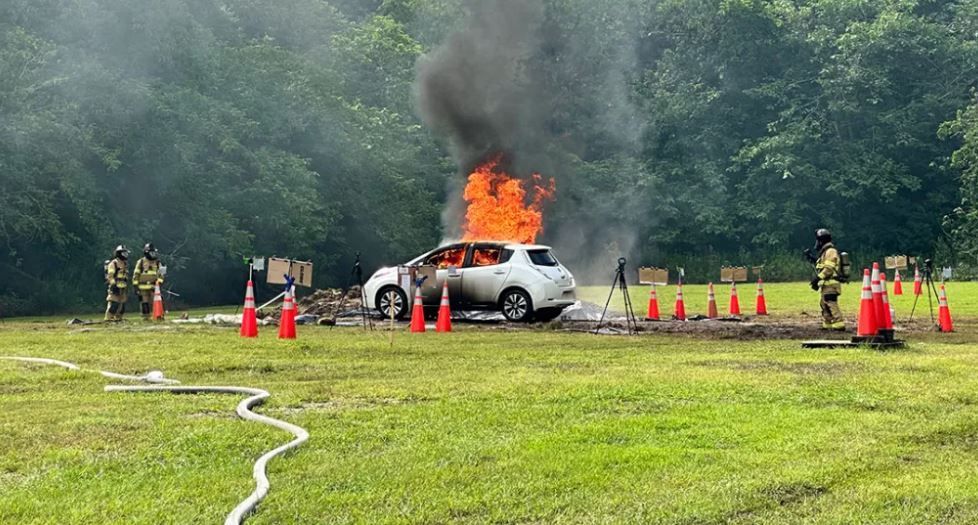
Alberto Caban-Martinez, Ph.D., D.O., M.P.H., Deputy Director of the Sylvester Firefighter Cancer Initiative (FCI) and Professor of Public Health Sciences at the University of Miami Miller School of Medicine, is leading a multidisciplinary, multi-institutional study of electric vehicle (EV) fires. Study collaborators, including the FCI, the Department of Chemical, Environmental and Materials Engineering, and the Department of Biochemistry and Molecular Biology at the University of Miami, in collaboration with several Florida fire departments, staged a fire at Florida State Fire College to study the effects of EV fires.
The risks associated with EV fires aren’t widely understood, which prompted the FCI-led study. Dr. Caban-Martinez and Erin Kobetz, Ph.D., M.P.H., Principal Investigator of the FCI, and Co-director and Principal Investigator of the Miami CTSI believe that this project is representative of the future of fire science, as EVs continue to increase in numbers throughout the world. The goal is to have more reliable information on the release of potential toxins contained within EVs on not only firefighters and community members, but also into the nearby environment (e.g., air, soil, water).
Data from the U.S. National Transportation Safety Board shows that there are approximately 25 fires for every 100,000 EVs sold. In comparison, there are approximately 1,530 fires for every 100,000 gas-powered vehicles sold. Similar rates have been found in Norway, Sweden and Australia. While EV fires are less common, they are more difficult to extinguish. Their lithium-ion batteries take a long time to cool, creating a danger of reignition. During an electric vehicle fire, more than 100 chemicals are released, including heavy metals, carbon monoxide and hydrogen cyanide. Controlling the fire can take hours, prolonging firefighter exposure to toxins, which highlights the importance of the Miami CTSI study.
Study researchers tested air, water and soil samples after the electric vehicle fire. The aim is to see how far the various toxins travel in each of the three mediums. The research group, the Aerosol and Air Quality Research Laboratory (AAQRL) at the University of Miami College of Engineering, participated in the study to improve safety measures during electric vehicle fire incidents, advocating for the use of wearable sensors to monitor the risk of exposure in real-time. Investigators also took breath, blood, saliva, urine and nail samples from the firefighters the day before the fire, the day of the fire, and the day after the fire. Additional sampling will continue for as long as a year in order to gauge longer-term effects.
The primary aim of the case study is to obtain important information about how toxins released in the environment from an EV fire impact firefighters and the broader community. It’s an exercise in team science, with scientists from medicine, engineering, transportation, water science and human biology contributing their expertise. These experiments will help address the safe development and advancement of modern transportation technology, and eventually help design next generation batteries to minimize EV fires.
Once the study is complete, the research team hopes to influence future behavior by enhancing firefighter protocols and public policy, including directives to the community in the event of an EV fire. The Miami CTSI is working to develop educational video modules that feature this project as an example of rigorous translational team science. The modules will be disseminated nationally. Additionally, Lieutenant Mike Adams, a fire investigator with the City of Miami Department of Fire-Rescue and active participant in the study, will help lead a public awareness campaign regarding EV batteries. One of Adams’ goals is to use findings from the study to increase awareness among firefighters and the public at large that EV batteries are not universally safe. Adams envisions a number of components for the campaign: workshops, public service announcements and more facilities for people to drop off their used batteries, with the ultimate goal being EV fire prevention.


