



Hub Spotlight: The University of California, Los Angeles CTSI
CCOS is pleased to continue our series of hub highlights showcasing groundbreaking advances in translational science from the CTSA Program. Today, we turn our attention to a pressing national issue: hospital bed shortages. We’re highlighting new solutions from the University of California, Los Angeles (UCLA) Clinical and Translational Science Institute (CTSI) to address the growing challenge of hospital capacity.
Hospital bed capacity is a critical yet often overlooked metric that shapes the quality and accessibility of healthcare in the United States. The daily census—the number of patients occupying hospital beds at any given time—serves as a barometer for the health system’s ability to meet demand. When occupancy rates climb too high, hospitals struggle to deliver timely, effective care, and patients can face dangerous and even deadly delays. A new UCLA study published in JAMA Network Open warns that, unless urgent action is taken, the U.S. could face a hospital bed shortage by 2032, with national occupancy rates projected to reach 85%.
The COVID-19 pandemic, while devastating, provided a unique opportunity to analyze hospital occupancy data in real time. Between August 2020 and April 2024, hospitals were required to report weekly occupancy numbers to the Department of Health and Human Services. This data set revealed a dramatic shift: prior to the pandemic, U.S. hospital occupancy hovered at 63.9%. In the year following the end of the public health emergency, that number jumped to 75%. The primary driver? A 16% reduction in the number of staffed hospital beds, falling from an average of 802,000 staffed hospital beds before the pandemic to just 674,000 staffed beds after.
This reduction in capacity is not simply a matter of fewer staffed beds from high nursing turnover, but is influenced by several factors, including hospital mergers and acquisitions, which can lead to the closure of acute care beds or their conversion to long-term acute care beds. Financial pressures, staffing shortages, and the high cost of maintaining hospital infrastructure have also contributed to the decline. Meanwhile, emergency department visits continue to rise, and the U.S. population is older and more medically complex than ever. Advances in the treatment of conditions like heart failure, kidney disease, and chronic obstructive pulmonary disease mean more people are surviving serious illnesses—but they also require ongoing, sometimes intensive, hospital care.
The implications of these trends are stark. Experts consider a national mean hospital occupancy rate of 85% or higher to be a general indicator of a bed shortage, which jeopardizes hospitals’ ability to reliably deliver safe, high-quality care. Richard Leuchter M.D., lead author of the UCLA study, warns that if the U.S. sustains such high occupancy, “it is likely that we would see tens of thousands of excess American deaths each year.” Already, stories have emerged of patients languishing in emergency departments for hours, days, or even weeks, waiting for an inpatient bed to become available. In some severe cases, patients have died while waiting for care, a grim reminder of the real-world consequences of strained hospital capacity.
What can be done to address both the shortage of beds and the incidence of unnecessary hospitalizations? One promising but expensive approach is the “hospital at home” model, popularized by researchers at Johns Hopkins University and serving as a model for similar initiatives nationwide. The program delivers acute care in patients’ homes using telemedicine and mobile health teams. Another is the development of next-day ambulatory care centers, which provide rapid outpatient follow-up for patients who might otherwise require admission.
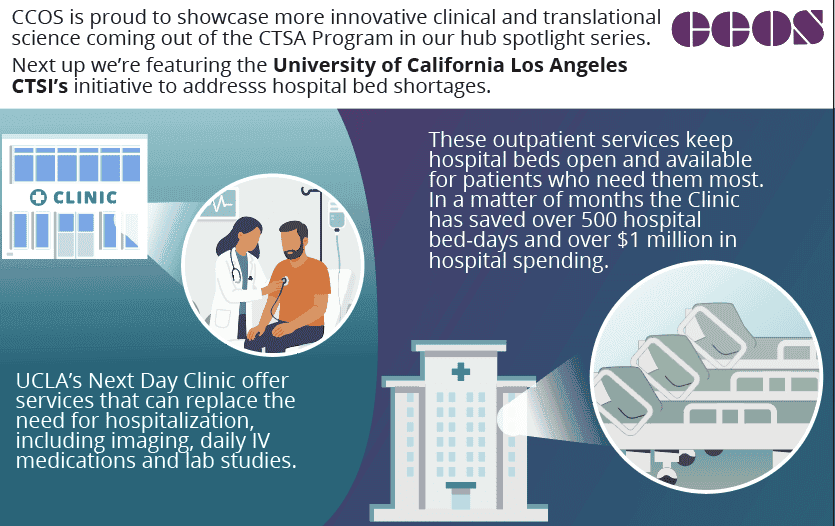
A standout example is UCLA’s Next Day Clinic (NDC), an initiative developed by Dr. Leuchter and his team in collaboration with UCLA Healthcare Value Analytics and Solutions (UVAS) and the UCLA CTSI Integrating Special Populations Program Hub. Based on a model Dr. Leuchter helped launch at Olive View-UCLA Medical Center, the NDC offers services that can replace the need for hospitalization, such as advanced imaging and daily IV medications and laboratory studies, in an outpatient setting. This allows patients who would otherwise be admitted to the hospital from the emergency department to receive timely, appropriate care without occupying a hospital bed. The clinic also facilitates earlier discharge for inpatients, freeing up beds for those in greatest need.
The NDC goes beyond medical care. It provides intensive outpatient case management and care coordination, addressing social factors that often drive hospitalizations, such as lack of transportation. For example, the clinic can fund ride shares to ensure patients have a reliable means to attend follow-up appointments.
The results have been impressive. In less than a year, the Olive View Next Day Clinic saved over 500 hospital bed-days and $1.09 million, earning recognition as the Top Oral Presentation at the Society of Hospital Medicine’s national meeting in April 2025. The model is now being tested at UCLA Ronald Reagan Medical Center in a randomized clinical trial to further assess its impact on hospital overcrowding.
Catherine Sarkisian, M.D., M.S.H.S., the UVAS Co-Director who was instrumental in launching the UCLA Next Day Clinic, emphasizes the importance of reducing low-value care, or hospitalizations that are avoidable and do not benefit patients. “With its focus on reducing low-value care, the UVAS infrastructure support is a perfect match with this line of work,” she says.
The challenge of hospital bed shortages is complex and multifaceted, shaped by demographic shifts, financial pressures, staff turnover, and evolving models of care. But as the UCLA study and the Olive View Next Day Clinic demonstrate, data-driven innovation and collaboration between researchers, clinicians, and health system leaders can offer real solutions. As the U.S. faces the prospect of dangerously high hospital occupancy rates in the coming decade, the need for such creative, patient-centered approaches has never been more urgent.


