



Hub Spotlight: Tufts Clinical and Translational Science Institute
CCOS is pleased to announce a new series of hub highlights featuring the innovative clinical and translational science coming out of the CTSA Program. We will feature groundbreaking work from each hub in the CTSA program over the coming months, with hubs selected at random. Next up on the docket is Tufts Clinical and Translational Science Institute (Tufts CTSI).
Traditional randomized controlled trials are often the gold standard for clinical research, but they are not always logistically or ethically possible, and they can have limited generalizability. Tufts CTSI, in collaboration with the New Drug Development Paradigms (NEWDIGs) group at Tufts Medical Center, developed the Clinical Trial Design Lab approach to innovative clinical trial development. Clinical Trial Design Labs support investigators in developing innovative clinical trial designs through a series of interactive sessions with multiple interest holders and subject matter experts. In 2024, Marisha Palm, M.Sc., Ph.D. and the Tufts CTSI team published the Design Lab Toolkit to share details of the approach with others who aim to support investigators to design and implement novel clinical trials. The CCOS Communications team sat down with Dr. Palm to discuss the benefits of the Design Lab methodology and how it has been implemented in practice.
What is the Clinical Trial Design Lab Toolkit?
The Design Lab Toolkit, according to Dr. Palm, is a guide to implementing the Clinical Trial Design Lab approach. It outlines the steps to organize and implement a Design Lab, including several resources like draft timelines, proposal scoring rubrics, and templates. The toolkit can be used from start to finish or one or more elements can be used to inform engagement of interest holders and support development of a trial design focused on impact.
Which Clinical Trials Will Benefit from the Design Lab Process?
Dr. Palm notes that not every clinical trial will benefit equally from the Design Lab process, so knowing when to use this resource is key. Design Labs are best used to address issues that arise for complex or challenging clinical trials; standard clinical trial designs are unlikely to require such specialized attention. The challenge could be that the disease of study is rare, the patient population is heterogeneous, or there are ethical issues with randomization. At Tufts CTSI, Dr. Palm’s team uses a rubric to evaluate Design Lab applications, assessing how innovative, impactful, and feasible the trial will be, among other criteria. Once trial proposals are selected, a Design Lab team is brought together.
What are the benefits of a Clinical Trial Design Lab?
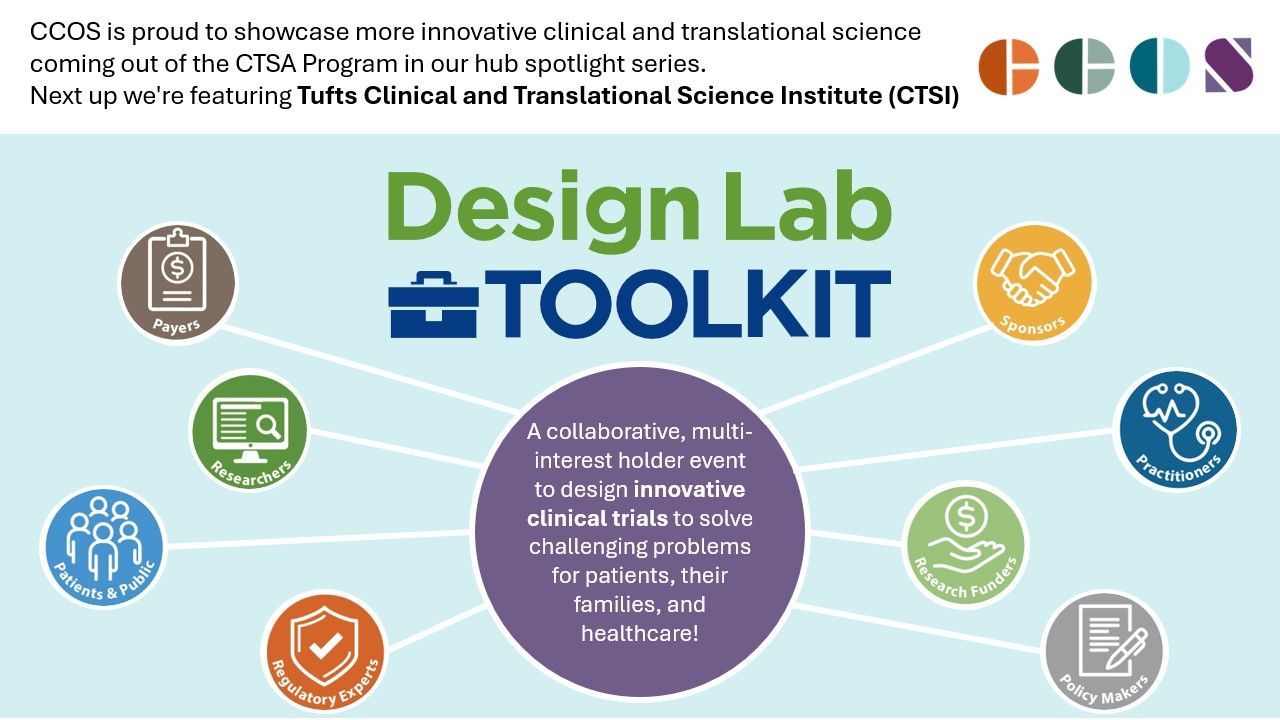
The largest benefit of a Clinical Trial Design Lab, from Dr. Palm’s perspective, is bringing all interest holder voices together to design an innovative clinical trial design that will improve the trial’s opportunity for impact and success. The interest holders that make up a Design Lab team include practitioners, researchers, patients, funders (public and philanthropic), sponsors, regulators, payers (like insurance companies), and policy makers. Each interest holder contributes to the overall success of the trial by contributing their knowledge and expertise to improving the feasibility, accessibility, relevance, and impact. With these varied perspectives contributing to development of the trial design, more individuals and communities are able to engage in and benefit from translational science, addressing one of the key needs of the NCATS Strategic Plan 2025-2030. The Design Lab methodology also speaks to the other two key needs in the Strategic Plan, namely increasing the availability of treatments by designing original trials that require a novel design and decreasing inefficiencies in translation by encouraging researchers to think well beyond scientific publications into real-world impact.
Implementing a Design Lab – a Crucial Collaboration
Since 2016, Tufts CTSI has held 14 Design Labs. Much of the initial work around the concept of Design Labs came from Tufts CTSI’s collaboration with the NEWDIGs team, then at Tufts CTSI partner Massachusetts Institute of Technology (MIT) and now at Tufts. Dr. Palm noted that the NEWDIGs group was crucial in laying the groundwork for Design Labs. “They were the perfect partners for us,” said Dr. Palm. “They had so thoughtfully developed their approach to bringing people together to create a space that would be collaborative even when there were potential proprietary issues or things that were sensitive. They thought a lot about how to create that space so that people could come together and share candidly to create and design together.” Tufts CTSI brought the idea of using the Design Lab approach to their work with the Trial Innovation Network (TIN). During the first TIN funding cycle (2016-2023), two national Design Labs per year were held as a benefit to TIN investigators developing novel trials. As Dr. Palm mentioned, not every trial should go through a Design Lab. The key is finding a sweet spot where investigators have sufficient background and direction for a trial but are seeking new trial designs and ways to make their work translate into benefits for patient health. Dr. Palm hopes Tufts CTSI can continue iterating on the format for Design Lab implementation to ensure investigators can benefit from this unique approach as policies and opportunities evolve.
A Design Lab Case Study on Pediatric Sjogren’s Syndrome
Pediatric Sjogren’s Disease is an “ultra-rare” pediatric autoimmune disease that causes extensive dryness throughout the body and may be accompanied by fatigue, chronic pain, or other debilitating symptoms. The rarity of this disease creates a challenge in recruiting a sufficient number of participants for a standard randomized clinical trial design. Two investigators, Dr. Sara Stern at the University of Utah, and Dr. Nora Singer at Case Western Reserve University, who are pediatric Sjogren’s experts aimed to design an “N-of-1” trial to rigorously evaluate treatment effects in a single patient. The rare disease population, a lack of pediatric outcomes measures, and unmet need for effective treatment made this a perfect candidate for a Design Lab. The N-of-1 approach has been one of the foci of the Design Lab contributions at Tufts CTSI. Though a Design Lab is confidential and may contain proprietary information in some cases, investigators gave Dr. Palm permission to share a summary of some key findings with CCOS.
The pediatric Sjogren’s disease N-of-1 Design Lab consisted of patients, parents, clinicians, statisticians, policy experts, and regulators. During the collaborative session, they discussed the following topics:
Types of evidence parents, clinicians, and regulators would need to adopt, prescribe, or approve new treatments
Parents’, patients’, and clinicians’ comfort level with different treatment regimens and study blinding
The importance of early FDA involvement
Inclusion and exclusion criteria
Primary and secondary outcome measures, including patient quality of life measures
How to handle disease flare ups during the study
The group also discussed generalizable aspects of the trial design for other rare pediatric diseases and whether it could act as a prototype for future trials. The outcome of the Design Lab was a successful R34 grant application, which is now supporting development of the trial with ongoing collaboration from some of the Design Lab experts. With the R34 set to wrap up in 2026, the CCOS team eagerly awaits the results!
Dr. Palm and Dr. Selker, the PI of Tufts CTSI and original proponent of use of the Design Lab to support innovations in clinical trials, hope that others can use the Design Lab Toolkit to bring together interest holders to design innovative clinical trial designs that improve their success and positive health impact. Tufts CTSI welcomes questions about the Design Lab Toolkit and inquiries about future collaborations, which can be sent to marisha.palm@tuftsmedicine.org


