


How a Research-Based Web Tool Is Making Patients Safer Nationwide
Summary
Article
Victoria Tiase, Ph.D., R.N., was there when everything changed. In the late 1990s, at the health care institution where she worked, patient health information was about to undergo a radical shift—moving from paper to electronic records for the first time.
“I could not help but think, ‘Wow, we are going to have so much data that we are going to do cool things with’,” Tiase says. “I could tell right away it was going to be groundbreaking.”
She was right. Electronic health records (EHRs) are now a cornerstone of medical systems, keeping track of patient clinical data, alerting clinicians to potential safety issues, and, in theory, contributing to the best medical care for every patient.
Why it Matters
Electronic health records (EHRs) are designed to record patient health data and alert providers to potential safety issues. But they can also lead to dangerous medication errors—a leading cause of harm to patients. Researchers at the U developed the Patient Safety Flight Simulator to test EHR guardrails, reducing the number of medication errors by 30–40% on average. The simulator is now being used to improve patient safety in 3,000 hospitals nationwide.
In practice, things aren’t so simple.
EHRs represent vast amounts of data that is organized and used in increasingly complex ways. While they can increase patient safety, using them incorrectly can also lead to serious mistakes.
Epidemiologist David Classen, M.D., has seen the consequences of those mistakes firsthand. “I was at the front lines of care,” Classen says of his time at a previous institution. “I saw how updates could cause safety problems. I saw situations where we gave drugs to patients that they were allergic to because the system wasn’t functioning properly, and it seriously harmed them and even in one case killed a patient.”
At the time, there were no tests to measure how EHRs worked in the real world. Seeing the real-life consequences of EHR failures, Classen knew something had to change. As an epidemiology researcher, he had an idea for a way forward.
Enter the Patient Safety Flight Simulator. Developed by Classen and powered by U of U Health’s Clinical & Translational Science Institute Biomedical Informatics Core (BMIC), for which Tiase is assistant director, this safety tool would in time move from a small research project to a keystone tool used by half the hospitals in the nation.
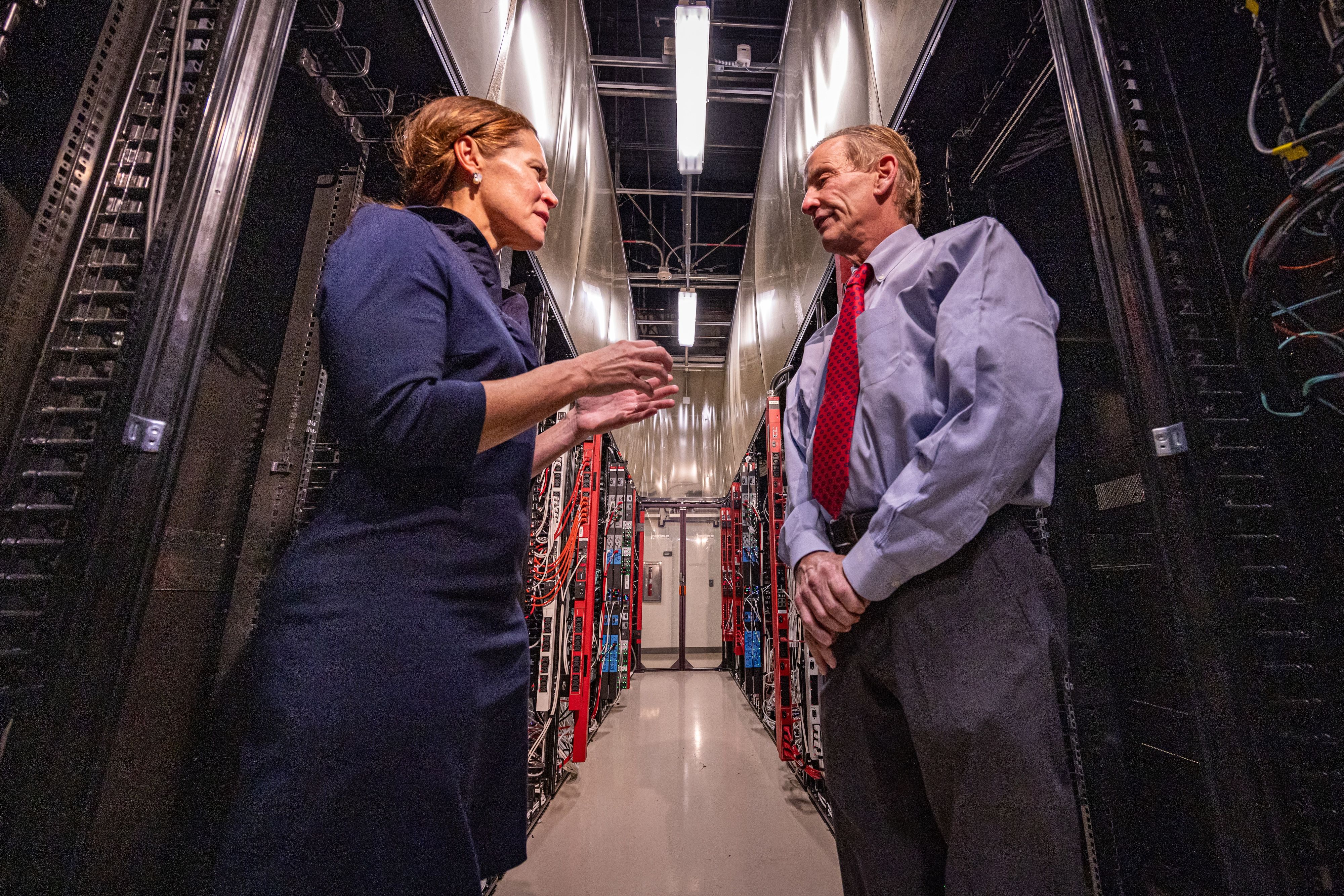
Victoria Tiase (left) and David Classen (right). Image credit: Charlie Ehlert / University of Utah Health
From idea to impact
The Patient Safety Flight Simulator is a web-based tool that hospitals can use to test their own EHR system for safety risks, running simulated medication orders on the hospital’s EHR and checking for common hazards like overdoses and dangerous combinations of medications.
It simulates the process around medication safety and basically stress tests the EHR in real time. So you can’t fake it. You can’t pretend that your EHR is working properly if it’s not.
Victoria Tiase, PhD, RN
This stress-testing leads to major safety upgrades for patients: hospitals that use the test reduce their number of medication errors by 30–40% on average.
The researchers first launched the simulator in 2009. Now, supported by a robust technology platform built and operated by the BMIC team, it’s used by 3,000 hospitals every year.
The Patient Flight Safety Simulator
A research-based advance that checks EHRs for common medication safety hazards
Used by 3,000 hospitals every year
One of the most-used tools developed by the U’s Clinical & Translational Science Institute
Prevents an estimated 250,000 medication errors annually
And use of the tool will only increase. The Patient Safety Flight Simulator is now part of the Centers for Medicare & Medicaid Services’ guidelines for EHR safety, which means that hospitals will soon be required to use it or risk losing Medicare revenue.
The next stage for the Patient Safety Flight Simulator is adapting it to monitor the AI systems that are starting to be integrated into EHRs, the researchers say. AI tools have the potential to process patient information in more complex and dynamic ways than previous systems, potentially improving risk prediction and advancing care. But with that complexity comes additional room for unexpected errors. The researchers note that the flight simulator has documented simulated errors in which AI-powered systems in the EHR allowed potentially fatal medication overdoses.
New AI modules are currently being added to the simulator, including a module that measures the safety performance of AI-based programs to detect sepsis, a life-threatening condition responsible for 20–30% of ICU admissions nationwide.
Despite the success of the Patient Safety Flight Simulator so far, Classen has no intention of resting on his laurels.
I feel a great deal of satisfaction that we’ve actually changed vendor products and made them safer, and we’ve made care for patients safer. But we’re not done yet.
David Classen, MD
https://ctsi.utah.edu/news/2026/11/how-research-based-web-tool-making-patients-safer-nationwide


