


From Evidence to Practice: CTSA Collaboration Powers a National Training Model
Summary
Supported by National Center for Advancing Translational Sciences (NCATS) and National Institute of Dental and Craniofacial Research (NIDCR), the National Dental Practice Training Center is developing a scalable model to move research evidence into everyday dental care. Beginning with pulpotomy, it combines clinical training, telementoring and informatics through CTSA collaboration. The Center for Clinical and Translational Science (CCTS), located at the University of Alabama at Birmingham (UAB), helped connect investigators with informatics expertise. The model could support additional dental procedures and offer lessons for other clinical disciplines.
Article
A new National Dental Practice Training Center, supported by the National Institutes of Health (NIH) through its National Center for Advancing Translational Sciences (NCATS) and National Institute of Dental and Craniofacial Research (NIDCR), draws on CTSA collaboration to address a persistent challenge in translational science: moving proven approaches from research into routine clinical practice.
Generating evidence is only part of the translational science journey. Ensuring that evidence reaches clinicians and ultimately patients can present an entirely different set of challenges. A new national initiative co-led by the University of Alabama at Birmingham (UAB) is taking aim at that gap.
The National Dental Practice Training Center (NDP-TC), led by Joana Cunha-Cruz, D.D.S., Ph.D., professor in the UAB School of Dentistry, and Rahma Mungia, B.D.S., M.Sc., DDPHRCS, of UT Health San Antonio, will develop and evaluate a scalable approach for helping clinicians adopt evidence-based procedures in everyday practice.
Supported through a Collaborative and Innovative Acceleration Award (UG3/UH3; NIH Award UG3TR006250) under the Clinical and Translational Science Awards (CTSA) Program, with funding from NCATS and NIDCR, the project brings together CTSA hubs at UAB, the University of Rochester, and The University of Texas at San Antonio, along with the National Dental Practice-Based Research Network (National Dental PBRN) and Project ECHO.
The collaboration will examine a broader translational question: What does it take to move strong evidence into widespread practice?
Starting with a Real-World Translational Gap
The center’s first test case is pulpotomy, a form of vital pulp therapy that preserves healthy pulp tissue within the tooth. Although supported by clinical evidence, its use as a definitive treatment for mature permanent teeth is not yet widespread in U.S. dental practice.
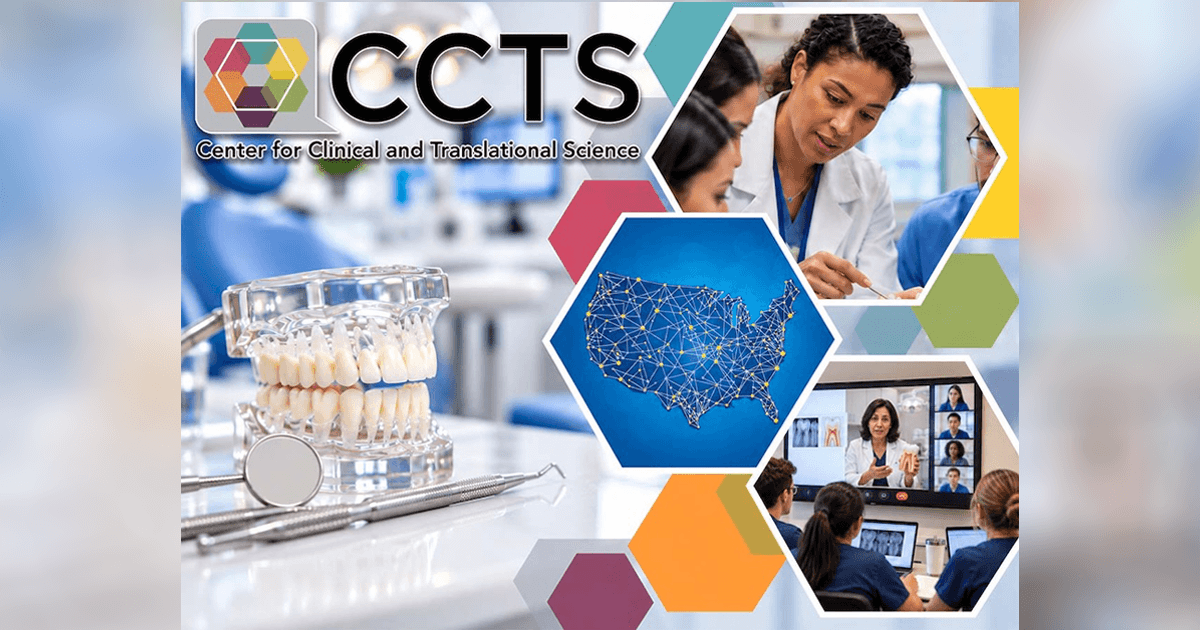
Joana Cunha-Cruz, DDS, PhDResearchers will first identify barriers that may prevent dentists from using the procedure, including gaps in knowledge or clinical training, lack of confidence, workflow challenges, and limited access to expert support. Those findings will inform a training program combining patient cases, peer and expert interaction, telementoring, and hands-on simulation using 3D-printed teeth.
The goal is not simply to provide continuing education. Investigators want to determine whether a structured, evidence-informed training model can change clinical practice.
“We know that producing strong evidence does not automatically mean that evidence will be adopted in practice,” said Cunha-Cruz. “This project gives us an opportunity to understand the barriers clinicians face and design training that helps move evidence into patient care more effectively.”
The project's two-year feasibility and planning (UG3) phase will focus on developing, piloting, and refining the training platform. If predefined milestones are met, a subsequent three-year implementation and execution (UH3) phase will expand the program across multiple CTSA hubs and rigorously evaluate its effect on clinicians' knowledge, skills, and adoption of the procedure.
Using the CTSA Network to Accelerate Translation
That multisite approach is central to the project's significance for the Center for Clinical and Translational Science (CCTS), located at UAB, and the broader CTSA Consortium. Rather than developing a solution within a single institution, the team is combining complementary infrastructure from CTSA hubs, the National Dental Practice-Based Research Network, and Project ECHO to create a model designed for dissemination and scale.
“This is exactly the kind of challenge the CTSA program is positioned to address. The opportunity is not simply to develop an effective intervention at one institution, but to use the collective expertise, infrastructure, and reach of the CTSA Consortium to understand how an evidence-based approach can be implemented, evaluated and ultimately scaled.”
Jennifer Croker, PhD
Senior Administrative Director, CCTS
The National Dental PBRN, whose national administrative base is housed at UAB, connects dental practices across the country to conduct research grounded in everyday clinical care.
“This is a great collaboration between two NIH institutes, NIDCR and NCATS, to accelerate movement of scientific evidence into everyday clinical practice,” said Gregg Gilbert, DDS, MBA, National Director of the National Dental PBRN. “The National Dental PBRN is thrilled to be part of a team to make this happen.”
Drawing on longstanding collaborative relationships with the National Dental PBRN, the CCTS helped connect the project with clinical research informatics expertise. Abu Saleh Mohammad Mosa, PhD, MS, FAMIA, vice chair for Clinical Research Informatics in the UAB Department of Biomedical Informatics and Data Science and co-director of Health Informatics for the CCTS, subsequently joined the collaboration.
“Training clinicians is only the first step,” said Mosa. “The real measure of success is whether that training leads to meaningful changes in everyday patient care. Clinical research informatics can help us understand and measure that transition, from acquiring new knowledge to adopting evidence-based procedures in practice. By combining informatics with implementation science and practice-based research, we can generate insights that help make effective clinical practices more widely adopted and sustainable.”
A Model Designed to Extend Beyond a Single Procedure
Although pulpotomy provides the initial use case, the investigators are designing the National Dental Practice Training Center as a reusable platform rather than a one-procedure initiative.
The federal award description identifies plans to expand the approach to 11 additional high-impact dental procedures beyond the award period. More broadly, the project's combination of implementation science, experiential training, practice-based research, informatics, and multisite collaboration could offer lessons applicable to other clinical disciplines facing similar evidence-to-practice gaps.
That broader potential is what makes the project especially relevant to investigators throughout the CCTS Partner Network and the CTSA Consortium. The challenge is familiar across translational science, where discoveries and clinical evidence can have limited impact unless effective approaches are successfully incorporated into routine care.
“Translational science is ultimately about improving health, and that requires us to think beyond discovery alone. Projects like this help us understand how evidence can move through the translational process and reach the clinicians and communities that can benefit from it.”
Orlando Gutiérrez, MD
Director, CCTS
For Cunha-Cruz and her collaborators, dentistry provides an opportunity to develop and rigorously test one solution to that much larger problem. If successful, the center could demonstrate a pathway for shortening the distance between evidence and everyday care, not only by asking what works, but by studying how to help what works become practice.
Stay Connected and Explore
Follow the work of the CCTS Partner Network and discover more opportunities to advance clinical and translational science:
View the NIH/NCATS award details to explore the official project abstract, funding information, and plans to expand the training model nationally.
Read the UAB News announcement for additional details about the award, investigators, and the tooth-preserving procedure at the center of the project.
Visit the National Dental Practice-Based Research Network to learn more about the national community of dental professionals conducting practice-based research and translating findings into everyday care.
Explore the NCATS Clinical and Translational Science Awards (CTSA) Program to learn how CTSA-funded institutions across the country are working together to accelerate the translation of research into improved health.
Subscribe to the CCTS Digest for the latest research news, funding opportunities, training, and events from across the CCTS Partner Network.
Follow CCTS on LinkedIn for Partner Network news, resources, and stories highlighting translational science in action.
https://www.uab.edu/ccts/news-events/center-news/from-evidence-to-practice-ctsa-collaboration-powers-a-national-training-model


