



Clinical Research Unit Study Facilitates FDA Approval for C3G Treatment
Summary
Recently, the University of Iowa's Clinical Research Unit (CRU) underwent an FDA inspection as part of a clinical trial for the new medication, oral Fabhalta, aimed at treating C3 glomerulopathy (C3G). Due to the ultra-rare nature of C3G, the CRU saw patients from all over the United States and Canada and was the number one enroller for the clinical research trial globally. “Due to our recruitment, our site was selected for and completed FDA Inspection,” Carla Nester, M.D., M.S.A., FASN shared.
Article
Oral Fabhalta becomes the first treatment for adults with C3 glomerulopathy (C3G).
Recently, the University of Iowa's Clinical Research Unit (CRU) underwent an FDA inspection as part of a clinical trial for the new medication, oral Fabhalta, aimed at treating C3 glomerulopathy (C3G).
Due to the ultra-rare nature of C3G, the CRU saw patients from all over the United States and Canada and was the number one enroller for the clinical research trial globally.
“Due to our recruitment, our site was selected for and completed FDA Inspection,” Carla Nester, M.D., M.S.A., FASN shared.
Understanding C3 glomerulopathy
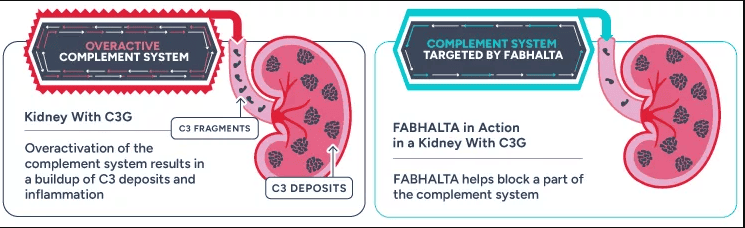
C3G is an extremely rare kidney disease caused by the malfunction of a portion of the immune system, the complement system. This malfunction damages the kidneys and often leads to kidney failure, requiring a kidney transplant. People living with C3G face mobility issues, high levels of fatigue, and mental health issues. This disease can affect anyone and has an average diagnosis age of 16. C3G has no cure, and historically, there have been no effective treatments for C3G.
Saying yes to a patient population in need
Nester is a world-renowned physician specializing in rare complement-mediated kidney diseases and an expert in C3G. She serves as the Principal Investigator for the study alongside Nicole Gerot, the study coordinator.
When the sponsor for the Fabalta study reached out to see if the University of Iowa would be interested in participating, “it was an instant yes! This population needs help,” Gerot explained.
The study was to evaluate the efficacy and safety of taking twice-daily oral Fabhalta in adult patients with C3G. The study consisted of a 6-month randomized, double-blind treatment period comparing Fabhalta to placebo, in addition to supportive care. The medication was so successful that, after the first 6 months, an additional 6-month open-label treatment period was initiated, during which all patients continued to receive the medication.
The oral Fabhalta targets the underlying cause of C3G by blocking the complement system, reducing protein in the urine, and reducing damage to the kidneys. Oral Fabhalta was the first treatment approved for patients with C3G.
Meaningful results for patients with C3G
The positive impacts of Fabhalta were seen as early as 14 days after taking the medication and sustained for 12 months. Before the approval of Fabalta, C3G patients had no other treatment options, relying only on supportive care, immunosuppression, and symptom management.
“This is the closest thing to a cure we’ve ever seen for this disease,” Nester shared.
A forward step
Oral Fabhalta’s FDA approval serves as a historic benchmark for patients with C3G. The drug has the potential to become the new standard of care for those living with C3G and gives hope for a better future for C3G treatment options.
“The FDA approval of oral Fabhalta for C3 glomerulopathy (C3G) is a pivotal moment for patients and for our Clinical Research Unit, because for the first time we have a targeted, oral therapy that addresses the underlying complement-mediated driver of this ultra-rare, often devastating kidney disease, rather than relying solely on supportive care and broad immunosuppression,” says Alejandro Comellas Freymond, M.D., the ICTS clinical research support director. “We are also extremely proud of our entire CRU team, whose dedication and expertise were essential to achieving this milestone. Just as other disease-modifying therapies have transformed outcomes in severe genetic and immune-mediated disorders, Fabhalta’s success in C3G opens the door to a new era of complement-directed treatments that may benefit a broader spectrum of glomerular and complement-driven diseases beyond C3G itself.”
https://icts.uiowa.edu/news/2026/06/clinical-research-unit-study-facilitates-fda-approval-c3g-treatment


