



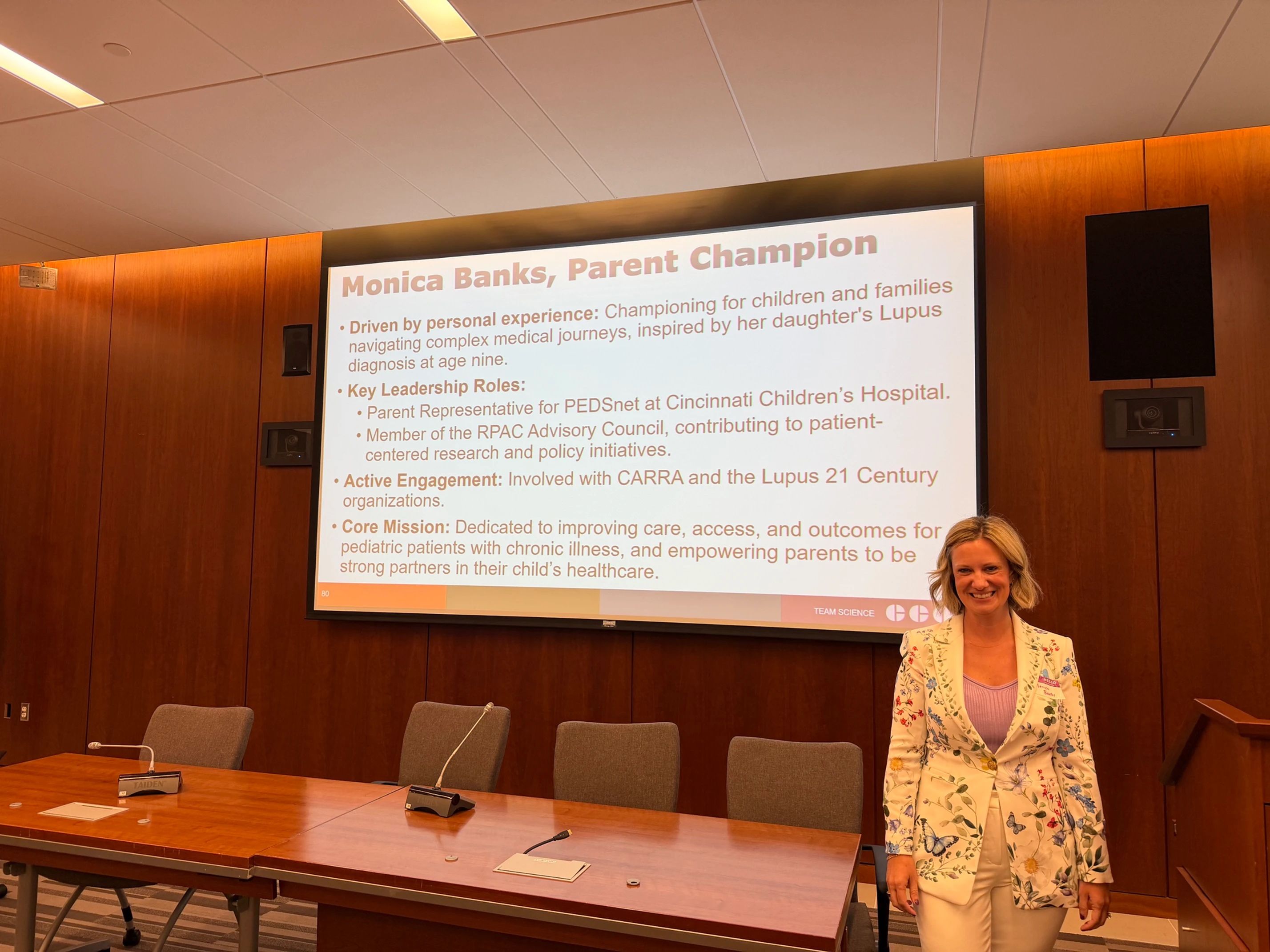
CCTST RPAG Member Shares Parent Advocate Perspective at National RWD/RWE Workshop
Summary
CCTST Research Participant Advisory Group (RPAG) member, Monica Banks, participated in a panel discussion at the collaborative workshop on real-world data (RWD) and real-world evidence (RWE), sharing her perspective as a parent advocate.
Article
Members from the Center for Clinical and Translational Science and Training (CCTST) recently attended and participated in the collaborative workshop on real-world data (RWD) and real-world evidence (RWE) in Washington, DC. Hosted by the Stanford School of Medicine, NCATS and CCOS, the event convened researchers, patients, industry experts, and government leaders to advance the future of RWD/RWE research.
Among the CCTST attendees was Monica Banks, who serves on one of the CCTST’s Research Participant Advisory Groups (RPAGs). The RPAG includes the University of Cincinnati Research Participant Advisory Council (UC RPAC), the Cincinnati Children's Research Participant Advisory Council (CCHMC RPAC), and the West End Community Research Advisory Board. These groups serve as valuable resources for investigators and research teams at Cincinnati Children's and the University of Cincinnati who are seeking participant and community perspectives to enhance the design, implementation, and impact of research conducted both within healthcare settings and throughout the community.
Monica participated in the panel discussion, “Governance Models for Sustainable and Trustworthy RWD,” where she shared her perspective as a parent advocate. Her advocacy journey began when her daughter was diagnosed with lupus at age nine. During her daughter’s treatment, she was supported by a dedicated team of physicians who were deeply involved in research. Throughout the process, she accepted her diagnosis and decided that she wanted to be part of a long-lasting solution, which included research. Over the years, she has participated in numerous research studies, including clinical drug trials. As a pediatric parent, Monica was along for the journey. Today, Monica’s daughter is entering her sophomore year at the University of Cincinnati and is pursuing a path toward becoming a pediatric rheumatologist. She remains involved in research and is currently participating in the Cincinnati Children's Summer Undergraduate Research Fellowship program.
Monica emphasized the importance of incorporating the patient perspective throughout the entire research process - from study conception and design to communicating findings back to the patients who contributed their data. Some of the key points she made:
- Families are often the continuity layer in a fragmented healthcare system. We carry timelines, symptoms, treatment responses, records, and outcomes across institutions and over years.
- Families are willing to share incredibly personal data when they believe the system is stewarding it responsibly, transparently, and ethically.
- Good governance is not just about protecting data. It’s about honoring the people behind it.
- In pediatrics, governance is uniquely complex because children eventually become adults. We need systems that respect both parental stewardship and the future autonomy of the patient.
- Families stay engaged when they feel respected, informed, included, and connected to outcomes over time.
- Reproducibility improves when participation burden is reduced. Otherwise, research will continue to overrepresent families with the time, resources, and stability to participate.
- The future of trustworthy real-world evidence depends not only on better technology, but on stronger partnerships with the families living these experiences every day.
Monica’s experience as a parent advocate has brought valuable insight and perspective to the Cincinnati Children’s RPAC. In a recent spotlight feature, Monica shared that serving on the CCHMC RPAC has been one of the most meaningful aspects of her advocacy journey, providing an opportunity to bring the patient and family perspective directly into research discussions. “The best research happens when researchers and families work as partners,” said Monica. “RPAC helps make that partnership possible. Families may not have the scientific expertise of researchers, but they are experts in living the experience. When those perspectives come together, research becomes stronger, more meaningful, and more impactful.”


