



Hub Spotlight: The University of Alabama at Birmingham Center for Clinical and Translational Sciences
CCOS is pleased to continue our series of hub highlights featuring the innovative clinical and translational science coming out of the CTSA Program. Today we’re exploring how the University of Alabama at Birmingham Center for Clinical and Translational Sciences is bridging the gap between benchtop and marketplace.
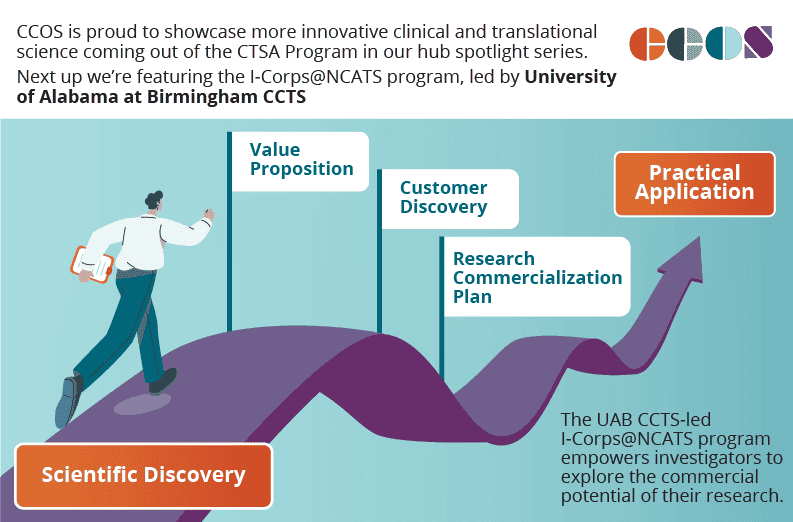
In the world of biomedical research, the journey from scientific discovery to practical application can be fraught with challenges. Bridging this gap is essential for translating innovative research into tangible benefits for patients and society. The I-Corps@NCATS program is a pivotal initiative under the CTSA Program and is led by the University of Alabama at Birmingham. The program was designed to help clinical and translational scientists learn how to use the process of customer discovery to explore the clinical need and market potential of their research.
The I-Corps@NCATS program is a five-week course modeled after the successful National Science Foundation's (NSF) Innovation Corps program. It combines business model training with a customer discovery process, aiming to prepare teams to apply for national programs at NSF or NIH. The course is tailored to help participants, regardless of their innovation's development stage, understand the commercial potential of their research. By focusing on entrepreneurship training and education, the program empowers scientists to engage effectively with the commercial sector, compete for funding opportunities, and connect with collaborators.
Since its inception in 2017, the I-Corps@NCATS program has made a significant impact on the biomedical research community. Initially launched as a pilot project across 9 CTSA hubs, the program's success led to its expansion to 13 additional hubs from 2020 – 2023. This expansion reflects the growing recognition of the importance of commercialization in advancing clinical and translational science. To date, 276 teams and 718 individuals have completed the program, with many going on to achieve remarkable success in their respective fields. Participants have utilized their newfound skills to secure funding, establish startups, and bring novel products to the market.
During the initiative’s inception, the leadership team hypothesized that investigators trained through the I-Corps@NCATS program would be more likely to develop impactful, innovative ideas based on real-world insights, take a more informed perspective about the evaluation of the clinical and commercial impact of an idea, and know how to quickly prototype and test new solutions in clinical settings—and they weren’t wrong. The program has proven to be effective at building what are known in the world of translational science as “T skills.” These skills are essential in bridging disciplines and integrating knowledge across domains and translational phases. The “T” shaped scientist is a systems thinker, a boundary crosser, a process innovator, a team player, and a skilled communicator. These skills stand in contrast to “D skills,” which reflect deep, domain expertise, like disease-specific knowledge and strong research skills. While similar to conventional scientists in their strong disciplinary foundation, “T” shaped scientists go further by demonstrating the ability to work across a wide range of domains and specialties.
The I-Corps@NCATS leads measured the impact of the program by assessing the change in participants’ self-perceived "T skills" before and after the program. Survey results and subsequent analysis showed remarkable success. The greatest increases in ability were noted in relation to systems thinking and skilled communication, while participants indicated the highest overall levels of ability in relation to their perceived ability to cross boundaries and be a team player.
Looking beyond the participants’ self-assessment results, there have been other notable success stories from the I-Corps@NCATS program. One of the most outstanding is Nonoxort, LLC, a startup associated with Auburn University. Nonoxort has developed a novel iron oxide MRI contrast agent that offers significant advantages over standard options currently available in the market. Their contrast agent is designed to enhance imaging quality while minimizing potential side effects, addressing a critical need in medical diagnostics. The success of Nonoxort underscores the potential of the I-Corps@NCATS program to foster innovation and drive commercialization in the biomedical sector.
Beyond these success stories, the I-Corps@NCATS program offers numerous benefits to the field of clinical and translational science at large. By promoting commercialization, the program helps ensure that research findings are not confined to academic journals but are instead translated into real-world applications that can improve patient care. This focus on practical implementation is crucial for advancing healthcare and addressing unmet medical needs.
Moreover, the program fosters collaboration and networking among scientists, entrepreneurs, and industry leaders. By connecting participants with experienced mentors and industry experts, the program creates a vibrant ecosystem that supports innovation and commercialization. This collaborative environment encourages the exchange of ideas and facilitates partnerships that can drive the development of new technologies and therapies.
The I-Corps@NCATS program also integrates with existing CTSA Program initiatives, leveraging resources such as technology transfer offices, NIH Research Evaluation and Commercialization Hubs (REACH), and bio-incubator spaces. These resources allow translational research to thrive and advance public health by training new entrepreneurs, supporting product development, fostering startup companies, and supporting small businesses.
The I-Corps@NCATS program represents a transformative initiative in the field of biomedical research. By equipping scientists with the skills necessary to navigate the commercialization landscape, the program accelerates the translation of research innovations into practice. Its success stories, such as Nonoxort, LLC, highlight the program's potential to drive innovation and improve healthcare outcomes. As the program continues to expand and evolve, it promises to play a pivotal role in shaping the future of clinical and translational science, ensuring that groundbreaking research leads to meaningful advancements in patient care.
For more on how I-Corps@NCATS is training T-shaped scientists, check out this article by CTSA Program researchers in the Journal of Clinical and Translational Science.


