



First-of-its-kind Treatment Helps Man Overcome Severe Depression
Summary
Article
For decades, Tom lived a life limited by severe, treatment-resistant depression. He’d been hospitalized for depression multiple times, and even tried to take his own life.
“I was tired of trying to navigate a world that terrified me,” he says.
Everything changed when he enrolled in a first-of-its-kind, personalized brain stimulation study at the University of Minnesota, which he now calls a "life-saving intervention."
Life in full color
The turning point arrived shortly after waking up from surgery, when the research team turned on the electrodes to activate the brain stimulation. He hadn’t experienced joy in years, but suddenly a profound emotional shift started to take hold.
"I remember the moment, I always will," he said. "It was indescribable. It was so overwhelming, and so emotional."
For the first time in years, the "gray tones" of his daily existence were replaced by something vivid. "I don’t know if I’d ever felt those emotions; it was so much," he said. "It was like I had been living my life in a black and white photo and I didn’t really know anything else. And on the opposite side, you have color photographs."
Looking back, he says that moment was just the beginning of finding himself. The treatment gave him a newfound ability to understand, process, and feel all of the emotion he’d lived without for so long.
His symptoms reduced as the weeks went on. At six months, he became free of depression symptoms. And it’s stayed that way for three years and counting.
“My life has been unimaginably changed forever,” he says.
Beyond a one-size-fits-all approach
What’s unique about the study is the multi-target, highly personalized approach.
Because every brain is different and depression manifests differently in each person, the research team targets several areas simultaneously based on each person’s unique brain structure to account for depression’s many symptoms.
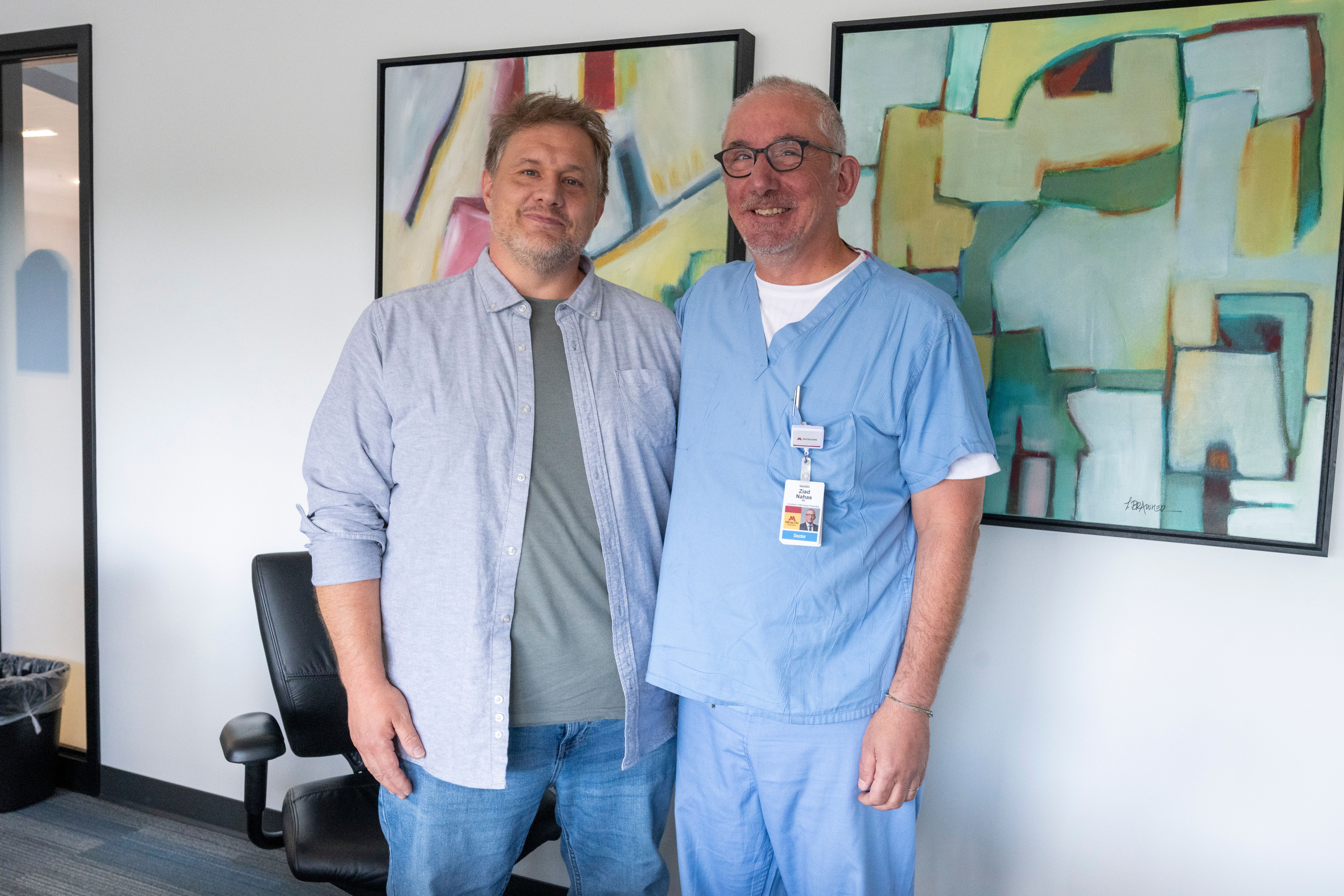
"We don’t believe depression is one spot or one unique network," says Ziad Nahas, MD, MSCR, a Professor with the University of Minnesota Medical School who led the study. "We conceive of depression as being the product of multiple complementary parts of the brain."
For this study, the research team used a specialized MRI technique to create a personalized map of each participant’s brain. This helped the team identify the best place to implant the electrodes used for brain stimulation therapy. For Tom, this meant strategically placing the electrodes in regions of the brain associated with joy, calm, and focus.
Then the research team worked with Tom to fine-tune the settings, so he could better experience a fuller range of emotions.
“With brain stimulation, the possibilities are infinite,” Dr. Nahas says, contrasting the technology with the relatively fixed boundaries of psychiatric medications and dosages.
Using a form of predictive modeling called Bayesian optimization helped the researchers efficiently find Tom’s favorite setting, one designed to stimulate calm and ease. Like “after taking a few deep breaths,” Tom says.
Navigating a complicated landscape
Bringing a first-of-its-kind study from concept to participant enrollment requires more than scientific innovation. It also requires researchers to traverse a complex terrain of regulatory, operational, and clinical research requirements.
For this, Dr. Nahas and team turned to the Clinical Research Support Center, which provided the study with specialized expertise for navigating the clinical trial’s immense complexity.
The Clinical and Translational Science Institute at the University of Minnesota is one of the many collaborators behind the center and provided the study team with a wide range of services and expert consultations.
"It’s one of the highest risk protocols with a lot of regulatory oversight; a very complicated landscape to navigate," Dr. Nahas said. "CTSI is one integral part of the web of events and people and expertise that need to come together in order to pull this off.”
This support began long before the first study participant was enrolled. Back when the team was planning the study, a feasibility review helped get the study ready for submission to the University’s Institutional Review Board (IRB).
This free, award-winning service brought together a wide range of experts to quickly and thoroughly review the study protocol. Experts weigh in on a wide range of considerations, from clinical workflows to participant safety to regulatory requirements, and provide actionable written feedback aimed at setting the study up for success.
Time-saving support
Then, the research team pulled in regulatory experts to submit the study to the IRB and provide ongoing support for the study’s U.S. Food and Drug Administration (FDA) and IRB requirements.
“The regulatory team is exceptional. They save me so much time and are so knowledgeable," says Rachel Johnson, MA, PhD, a University of Minnesota researcher who partnered with Dr. Nahas on the study. “We can get answers to our questions much more speedily than if we had to navigate everything on our own.”
Regulatory specialists have assisted with more than 60 IRB modifications, plus they update consent forms and maintain regulatory documents.
Time savings also came when they helped the study team make the change from physical regulatory binders to Florence eBinders, which the Clinical and Translational Science Institute brought to the University of Minnesota to streamline and enhance the way research is conducted.
“Shifting to Florence eBinders has been a game-changer,” says Dr. Johnson, noting that the switch gives the research team an efficient, compliant way to electronically sign, manage, store, and collaborate on study documents.
Ensuring compliance
The study also receives dedicated, specialized support for FDA submissions. This includes submitting the initial Investigational Device Exemption (IDE) application, annual reports, and amendments.
Regulatory experts also update the study record on ClinicalTrials.gov and serve as the study’s clinical trial monitors, helping ensure compliance with a wide range of guidelines and regulations and protect the rights and well-being of participants.
“Our monitor is very detail-oriented, which is great, because that's really what you need when somebody is making sure that you're audit-ready,” says Dr. Johnson.
Accelerating research
Receiving support for the complex regulatory requirements of a clinical trial enabled the researchers to stay focused on bringing the study to life.
"I don't think it's possible to understate how much further along our research is, because of the regulatory expertise available to us," Dr. Johnson said. "It's really nice to have people who understand the very complex requirements of studies like ours, so that we can focus on the science, the participants, and the data."
Hope renewed
The clinical trial continues to gain momentum. Three recent participants are showing encouraging results from the treatment, while a fourth is poised to begin. Thanks to a recent influx of funding, the research team is now expanding the study to determine if this same approach can effectively treat bipolar depression.
For Tom, the study has resulted in a life reclaimed. He now considers himself in remission, enjoying the simple but profound ability to be present in his own life.
"It’s given me the opportunity to do so many more things and be open to the world around me,” he says. “I can participate in life and have hope.”
https://ctsi.umn.edu/news/first-its-kind-treatment-helps-man-overcome-severe-depression


