



Hub Spotlight: North Carolina Translational and Clinical Sciences Institute - Pioneering Patient Engagement in Clinical Research
CCOS is pleased to continue our series of hub highlights featuring the innovative clinical and translational science coming out of the CTSA Program. Today, we’re dissecting the details behind a strategy that the North Carolina Translational and Clinical Sciences (NC TraCS) Institute at the University of North Carolina at Chapel Hill is using to expand patient engagement in research.
Early engagement of patients and communities is crucial for research, as it ensures that studies are relevant, useful, and reflective of the needs and priorities of the communities they aim to benefit. Engagement entails the meaningful involvement of community members, patients, caregivers, clinicians, and other partners in the research process, from design to dissemination. This approach helps to refine proposals, identify potential barriers to recruitment and retention, and ensure that research materials are suited to the community they serve. However, early engagement is often challenging, due in part to the lack of dedicated funding to support these activities, making it difficult for researchers to involve community partners effectively.
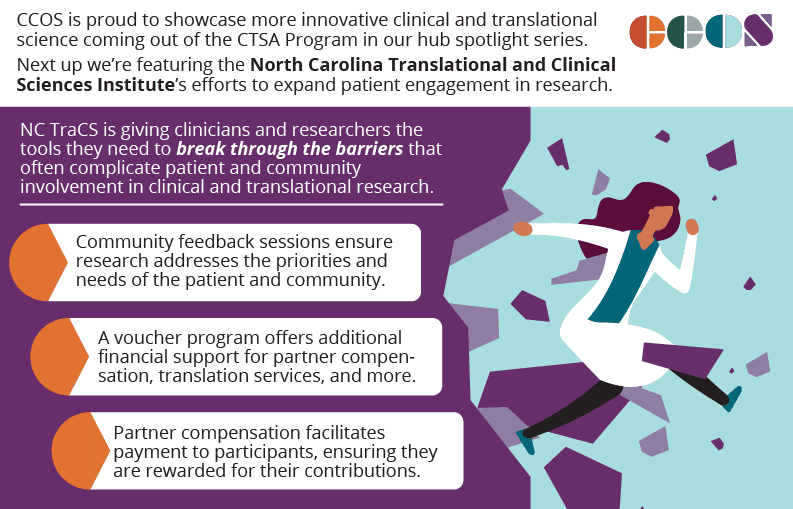
The North Carolina Translational and Clinical Sciences (NC TraCS) Institute is addressing this challenge with the Patient and Community Engagement in Research (PaCER) program. The PaCER program is designed to facilitate engagement between academic, clinical, patient, and community partners across North Carolina. The program offers a variety of services, including consultations, community feedback sessions, meeting facilitation, coaching, and training to support all phases of health research projects. By providing these resources, PaCER ensures that community input informs research that addresses the priorities and needs of the communities they serve.
One of PaCER’s standout initiatives is the Engagement Voucher Program, launched in 2024. This program offers up to $5,000 per award to support research engagement activities, such as partner compensation, meeting facilitation, and translation services. In its first round, five early-career investigators received funding totaling $26,136 for projects focused on engaging distinct populations such as older adults with advanced cancer, patients with arthritis, and autistic youth. This funding is crucial for engaging these populations in thoughtful, flexible ways that recognize their diverse needs and experiences and ensure their meaningful partnership with researchers.
Beneficiaries of the Engagement Voucher Program often utilize a popular PaCER Program service – community feedback sessions – to enhance their research. Trained PaCER staff facilitate sessions with patients and key community members to gather input on the design, implementation, and/or dissemination of scientific research. Community feedback sessions typically last 1.5 - 2 hours and aim to elicit authentic and constructive feedback from a small group of interest holders. Since starting in 2022, PaCER has conducted 40 community feedback sessions across 18 different research projects, with over 250 participants. Researchers who have provided feedback on this service unanimously state that they would recommend it to their colleagues, clearly indicating the myriad and valuable benefits of community feedback sessions.
The success of the Engagement Voucher Program has been so significant that a second round of funding is planned for early 2025. This program has also inspired other CTSA hubs to develop similar initiatives, demonstrating both its impact and effectiveness. By fostering early engagement, the program not only enhances the relevance and quality of research but also builds trust and collaboration between researchers and communities.


