

Impact Story • Success Story
SLiCE: A New Way to Study Brain Cancer and a Powerful Example of Translational Science in Action
By Michelle Maclay(1)
All Authors and Affiliations
Affiliations:
1. NC TraCS Institute
Posted April 21, 2026
Featured CTSA Institutions:
Duke University
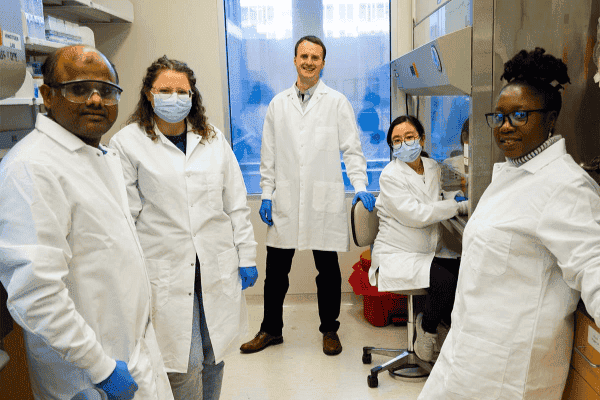
SLiCE Core team standing in the lab.
Photo by: NC TraCS Institute
Abstract
SLiCE (Screening Live Cancer Explants) is a breakthrough University of North Carolina at Chapel Hill developed technology that tests patient tumor samples on living tissue, creating a realistic environment for studying brain cancer. Developed by Drs. Andrew Satterlee, Shawn Hingtgen, and Albert Baldwin, and strengthened by NC TraCS translational science training, SLiCE enables tumors to behave as they do in the body and allows researchers to test multiple drugs within days. This platform has become a UNC Core Facility and is already driving major collaborations to accelerate preclinical drug development, including work with Nobel laureate Aziz Sancar, showing that the repurposed agent EdU outperforms standard chemotherapy in several glioblastoma samples. SLiCE is now paving the way for functional precision medicine, offering faster, more accurate, and personalized treatment insights for patients.
<10%
3 out of 5
>50%
Impact Story
Brain cancer, particularly the aggressive form known as glioblastoma, remains one of the most challenging diseases to treat. Fewer than 10% of adults diagnosed survive beyond five years, and treatment options have changed little in the past two decades. One major reason for this slow progress is the difficulty of studying glioblastoma in a way that truly reflects what happens inside the human brain. Once removed from the body, tumor cells often die, and those that survive typically behave very differently when grown on standard plastic lab dishes. Without a realistic, reliable model of the disease, scientists have struggled to test new drugs or predict which treatments might help patients.
At the University of North Carolina at Chapel Hill, a breakthrough technology is changing that. It’s called SLiCE, short for Screening Live Cancer Explants, and it was developed by UNC-Chapel Hill researchers Andrew Satterlee, Ph.D., Shawn Hingtgen, Ph.D., and Albert Baldwin, Ph.D. SLiCE engrafts tumors on substrates of living tissue to keep patient tumor samples growing in an environment that feels natural. This creates a tiny, living microcosm of the brain right on a lab bench, giving scientists an entirely new way to study cancer.
What makes this approach especially meaningful is how it combines creativity, personal motivation, and the power of translational science training. With support from the North Carolina Translational and Clinical Sciences (NC TraCS) Institute, UNC’s NCATS Clinical and Translational Science Awards (CTSA) hub, Drs. Satterlee and Hingtgen learned how to turn a research idea into a real-world medical platform. Today, SLiCE is a UNC core facility being used in major research collaborations, including one with Nobel laureate Aziz Sancar, M.D., Ph.D., to explore promising new anti-cancer agents.
A Personal Motivation
Satterlee’s journey toward developing the SLiCE platform began when he was diagnosed with a rare brain cancer in 2007, when he was 20 years old. As a college student, Satterlee and his family had to navigate a therapeutic odyssey that included brain surgery, chemotherapy, and radiation therapy. Satterlee’s family sought advice from several top doctors who did not agree on what treatments he should receive, and it was eventually up to Satterlee himself to decide how to proceed. At the time, Satterlee thought, “There must be a better way to do this.” He is building that tool today.
SLiCE Fills a Gap in Cancer Research
Satterlee’s case isn’t unique; studying brain cancer has always been a challenge. Even though these tumors grow rapidly inside patients, they often fail to survive when moved into lab conditions. On plastic lab dishes, tumor cells lose their structure and behavior. In animal models, experiments can take months and the cancer still may not behave in the same way it does in a real person. For this reason, we don’t know for sure if treatments that work in the lab dish will really work in a person.
SLiCE offers a “best of both worlds” solution. By placing a patient’s tumor directly onto the SLiCE platform, the tumor continues to thrive in a realistic setting, surrounded by living brain cells. This environment helps preserve the tumor’s shape, growth patterns, and behavior. Researchers can then apply different drugs directly to the tumor to determine which treatments are most effective at killing the cancer cells. Within just four days, SLiCE can generate meaningful results with the speed of a cell culture assay and the fidelity of an animal model. This combination of speed and complexity makes SLiCE especially promising for both preclinical drug development and precision medicine, where treatments are chosen based on how a specific patient’s tumor responds.
With SLiCE, scientists can test multiple drugs at once on real tumor tissue, observe how those tumors respond in real time, and generate faster, more accurate predictions about which treatments are most likely to work. Because different drugs might work better for one tumor than another tumor, this approach may allow SLiCE to “customize” treatment to each patient. This powerful approach reflects exactly the kind of translational science the CTSA program is designed to support, turning laboratory insights into tools that can directly impact patient care.
Translational Training That Sparked Innovation
Dr. Andrew Satterlee’s and Dr. Shawn Hingtgen’s training as NC TraCS Scholars equipped them with the translational mindset needed to rethink how cancer models are built. Early in his work with Hingtgen, Satterlee noticed that some tumor cells were not migratory in a dish, but inside the body, they behaved completely differently, rapidly invading throughout the brain. “Why would we design a therapy using a totally artificial model?” Satterlee recalls. Guided by the translational principles they learned through the TL1 (Satterlee) and K12 (Satterlee and Hingtgen) programs, the two scientists and their teams developed SLiCE technology. On SLiCE, the cells grew much like they do in an animal, revealing a far more realistic model for studying disease. This ability to question past teachings, adopt clinically relevant approaches, and bridge basic science with patient?focused innovation led to a multi-institutional U01 grant from the NIH’s National Center for Advancing Translational Science (NCATS) and has helped their larger team transform SLiCE into a platform now poised for broad use across many neurological diseases including Alzheimer’s disease and stroke.
A Breakthrough: SLiCE Meets Aziz Sancar’s Discovery
One of the most exciting uses of SLiCE came when Nobel laureate Aziz Sancar and his team discovered something surprising about a lab chemical called EdU. EdU is normally used to track cell division, but Sancar’s lab found that EdU can cross the difficult-to-penetrate blood-brain barrier, and cause death of cancer cells.
This discovery hinted that EdU might be able to attack glioblastoma in ways that standard chemotherapy cannot.
Sancar partnered with the SLiCE team to test this hypothesis by treating patient glioblastoma tumors with EdU on SLiCE. A series of experiments, led by Humeyra Kaanoglu, a PhD candidate in Sancar's lab, and Adebimpe Adefolaju, a Ph.D. candidate in the Hingtgen Lab, showed that EdU repeatedly outperformed temozolomide, the only FDA-approved chemotherapy for glioblastoma. Furthermore, combination therapy studies on SLiCE revealed that EdU may synergize with several other FDA-approved chemotherapies to further increase tumor kill. These studies led to two high-impact publications in less than one year.
This early success suggests that EdU, or drugs like it, could become powerful new tools in treating brain cancer.
Toward a Future of Personalized Treatment
SLiCE is helping shift the field toward functional precision medicine, where doctors choose treatments based on how a patient’s own tumor responds, rather than relying only on tumor imaging or genomic information about the tumor. Imagine a future in which a patient is diagnosed with glioblastoma, surgeons remove a small part of the tumor, the sample is placed onto the SLiCE platform, where several drugs are tested, and within days doctors know which therapy is most likely to work. This kind of personalized approach could help patients avoid ineffective treatments, reduce harmful side effects, and improve their chances of survival.
A Translational Success Story
SLiCE is much more than a laboratory technique; it is a model for how translational science should work.
- A young scientist receives CTSA training.
- The scientist develops a new technology to solve a real medical problem.
- That technology becomes a core resource used by many research teams.
- An inventive (and in this case, Nobel Prize-winning) collaborator uses the platform to test a promising new drug.
- And together, they move closer to improved treatments for one of the deadliest cancers.
For patients and families facing brain cancer, SLiCE represents something rare: genuine hope.
With the support and collaboration of NC TraCS, the CTSA program, and NCATS, innovators like Dr. Andrew Satterlee are building the tools needed to bring scientific discoveries out of the lab and into the lives of the people who need them most.
“We've got to think about things differently,” Satterlee says. “And that's what TraCS and NCATS—and what we—want to do.”


