

Impact Story • Success Story
Early Check: Helping North Carolina Babies Get a Healthy Start
By Michelle A. Maclay(1)
All Authors and Affiliations
Affiliations:
1. NC TraCS Institute
Posted April 21, 2026
Featured CTSA Institutions:
Duke University
Wake Forest University Health Services
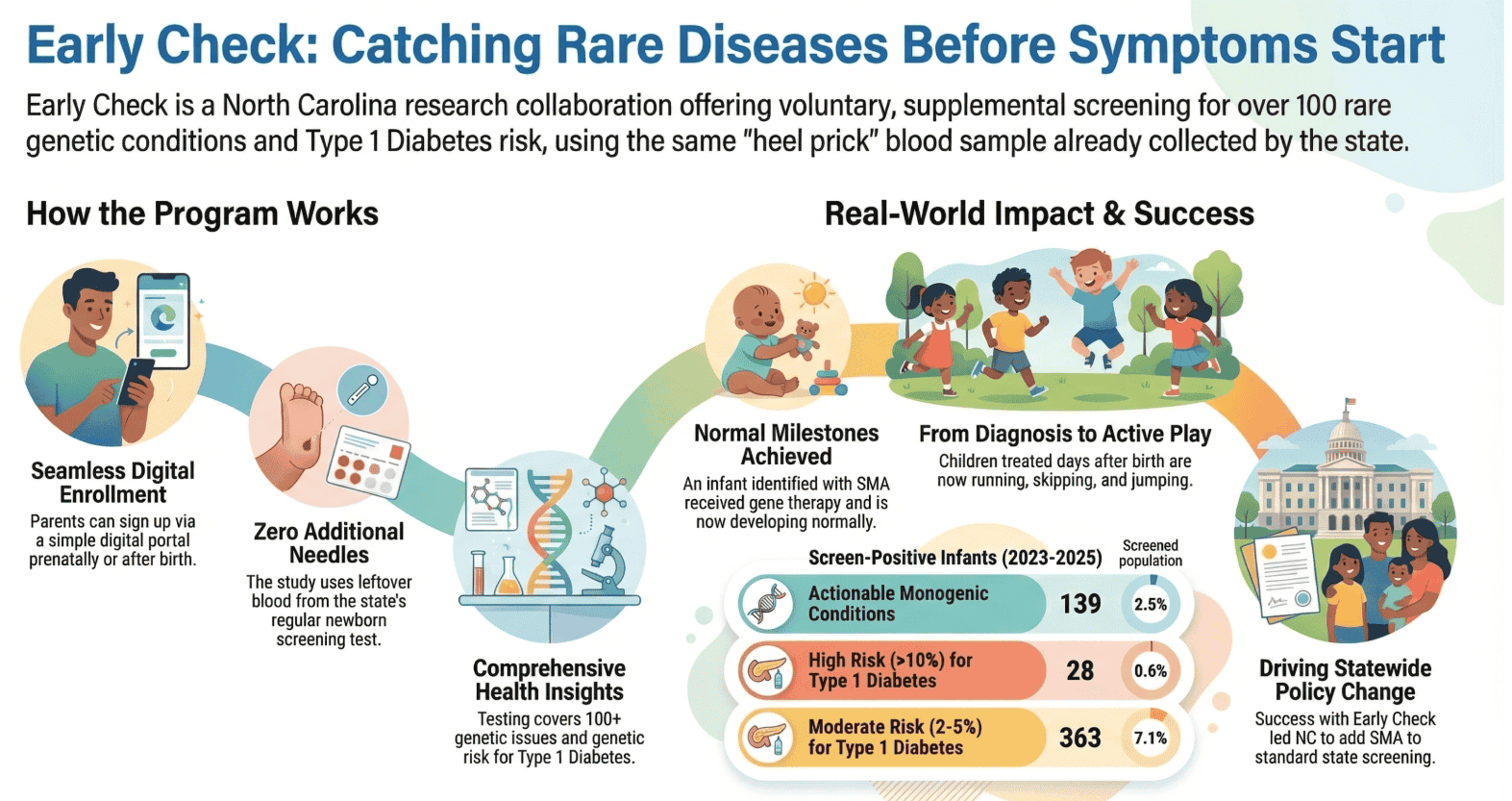
Infographic for "Early Check: Catching Rare Diseases Before Symptoms Start"
Photo by: NC TraCS Institute
Abstract
Early Check is a newborn screening research program in North Carolina that is finding rare but treatable conditions in babies early, often before symptoms appear. The program tested the ability to use a tool called whole genome sequencing, which reads a baby’s DNA, to check for more than 200 conditions at once. About 93% of enrolled newborns were successfully tested using leftover blood from routine screening, showing the program works within the state’s current system. Of 5,579 babies screened, 139 were identified at risk for rare genetic conditions for follow-up. Screening for Type 1 Diabetes found 216 infants with a higher lifetime risk of developing the disease, allowing parents to monitor their children for signs, symptoms, and identify a diagnosis more quickly should signs appear. A baby in Charlotte received gene therapy at eight weeks old and is now developing normally, while two sisters treated at birth are now running and playing like other kids.
93%
2.5%
210
Impact Story
Early Check is a newborn screening research program in North Carolina that looks at different ways to find rare but serious health conditions in babies before symptoms ever appear. By identifying certain disorders early, sometimes even before a baby shows any signs, doctors can provide treatments that may prevent disability, serious illness, or even death. The program started as a unique partnership between RTI International, the North Carolina Division of Public Health, and three major universities in North Carolina: The University of North Carolina at Chapel Hill, Duke University, and Wake Forest University. These universities are part of the National Clinical and Translational Science Awards (CTSA) Consortium, funded by the National Institutes of Health, that helps turn scientific discoveries into real-world medical care.
How Early Check Works
Every newborn in North Carolina receives standard newborn screening on a routine blood test, commonly known as the “heel prick,” which screens for a limited number of serious medical conditions. Early Check gave parents the option to add additional testing for other health conditions (at no cost) to check for several rare but treatable disorders.
A key feature of Early Check is that it does not require another blood draw. Instead, it used leftover dried blood spots from the state’s official newborn screening test. This made the process simple for families, with no extra procedures for the baby. During the project, the research team tried a tool called whole-genome sequencing. This tool reads a baby’s DNA and can check for more than 200 health conditions at once. This is a big improvement over traditional newborn screening, which can only look for a much smaller number of conditions using older lab methods.
The program also helps researchers understand how parents respond to this additional newborn screening, how well digital enrollment works, and whether the already existing screening system can support the additional testing done as part of Early Check. Because Early Check operates statewide, it was designed to answer questions about healthcare access and the ability to reach families in all communities.
Between September 2023 and October 2025, a total of 5,744 babies from across North Carolina were enrolled in Early Check. The program was open to parents for 31 days after the birth of their baby. Families often learned about it through mailed information or through the program’s easy-to-use online portal.
Why Expanded Screening Matters
Many rare genetic conditions are hard to detect at birth because symptoms often appear later, only after some organs are damaged. But early detection can change a child’s entire future. Treatments for some conditions work best, or sometimes only, before symptoms begin. Early Check aimed to find out how well newborn screening for these rare diseases works in real-world conditions and what benefits it can bring to children and families.
Real-Life Impact on Families
While data shows how effective the program is, the stories of individual children highlight its true importance.
One of the most powerful examples is Early Check’s work with spinal muscular atrophy, or SMA. SMA is a rare disease that affects muscles, causing weakness and sometimes trouble breathing. SMA can be life-threatening. Treatments exist, but they are most effective when given before symptoms appear.
Early Check has helped several infants receive life-changing treatment:
- A baby from Charlotte was diagnosed with SMA through Early Check and received gene therapy at just eight weeks old. Thanks to early treatment, he has reached major milestones like rolling over—something that might not have been possible without early detection.
- Two sisters were diagnosed at birth through Early Check. They were treated right away and today can run, jump, and play like other children their age.
Because of the proven value of detecting SMA early, North Carolina officially added SMA to its universal newborn screening panel in May 2021. This means every baby born in the state is now automatically screened for SMA, showing how research can directly improve public health policy.
Key Findings from Early Check
Early Check showed strong success in several important areas:
- High Testing Completion
About 93% of enrolled babies were successfully screened using leftover dried blood spots. This shows the feasibility of using dried blood spots for genomic screening.
- Identification of Treatable Genetic Conditions
Out of 5,579 babies tested for certain genetic disorders, 139 infants—about 2.5%—showed results that required follow-up. Follow-up testing confirmed several diagnoses, including cystic fibrosis, X-linked hypophosphatemic rickets, Pendred syndrome, Rett syndrome, spinal muscular atrophy, and Becker muscular dystrophy. Because these conditions are rare and usually silent in infancy, many of these babies likely would not have been diagnosed until later in life. Early detection of these conditions allows children to begin treatment and supports early intervention, which can prevent or reduce serious health problems like weak bones, muscle loss, breathing issues, or hearing loss. Starting care sooner also helps families plan and gives children a better chance to grow, develop, and stay healthier over time.
- Early Detection of Type 1 Diabetes Risk
The program also screens for markers that predict the risk of developing Type 1 Diabetes (T1D). Among 5,090 babies tested, 210 infants were found to have a higher lifetime risk of developing Type1 Diabetes, allowing parents to monitor their children for signs and symptoms.
- Expansion of the Universal Newborn Screening Panel
Because of Early Check, the State of North Carolina added Spinomuscular Atrophy to the universal newborn screening panel. This means every baby born in the state is now automatically screened for SMA and may have the chance at a normal life.
Why Early Check Matters for the Future
Early Check is more than a research study; it is a model for how states could expand newborn screening in the future. It shows that:
- Large-scale voluntary participation is possible.
- Signing up to get the test through the internet works well for new parents.
- Existing blood samples can be used to screen for more diseases without extra procedures.
- Early detection can lead to life-changing treatments.
- Research can guide public health decisions that affect every newborn.
As new treatments and screening technologies emerge, programs like Early Check will play a crucial role in making sure babies get the healthiest start possible.
“After speaking with our pediatrician and realizing how enrolling our son in this study could make a difference, we decided to register,” said the mom whose intuition also played a role in her family’s decision. Little did she know her gut decision would allow her child to live a more normal life.


