

Impact Story • Success Story
Bringing Speech-Language Innovation Home to Our Communities: CTSA-Supported Seed Funding Helped Launch Storilly
By Prashant Malhotra(1), et al.
All Authors and Affiliations
Affiliations:
1. Nationwide Children's Hospital
Posted November 18, 2026
Featured CTSA Institutions:
Ohio State University
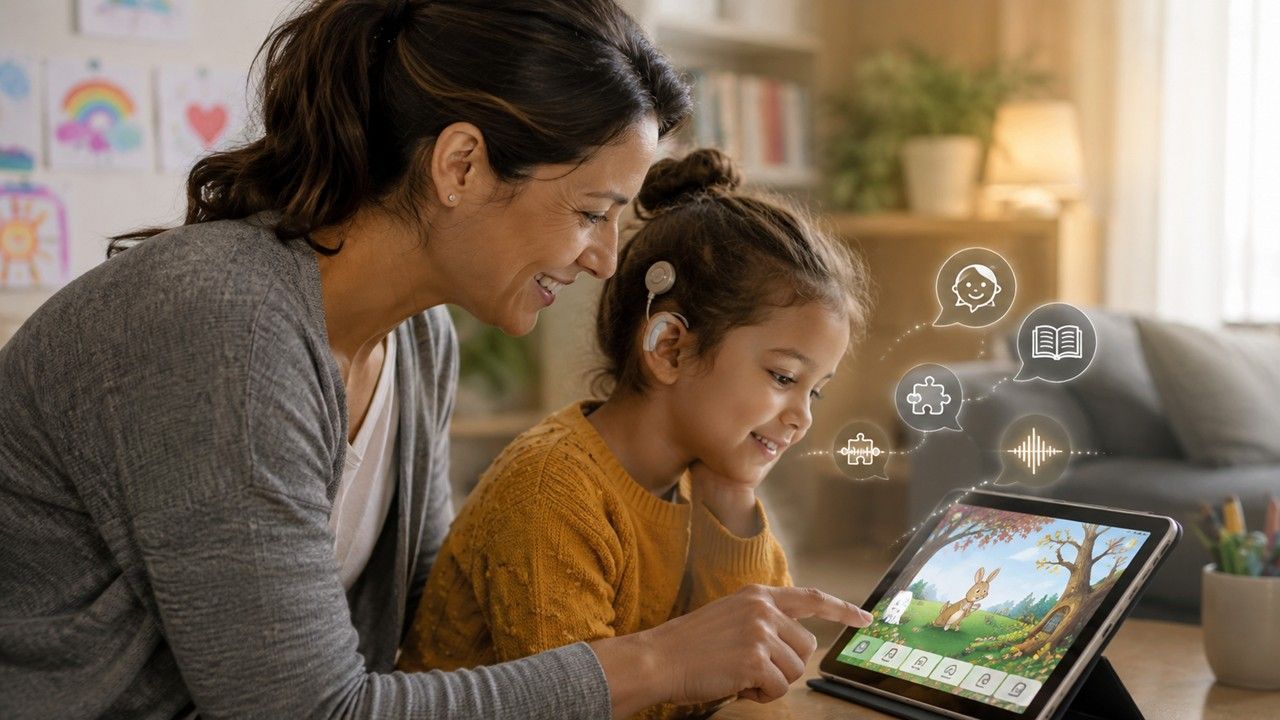
A parent and child read together using Storilly, a digital storybook and parent-coaching platform for children’s speech and language growth.
Photo by: Ohio State University CTSI
Abstract
A family’s experience with childhood hearing loss inspired a team at Nationwide Children’s Hospital to create Hear Me Read, a digital storybook tool that later grew into Storilly, a parent-coaching platform for children’s speech and language growth. Two early awards from a CTSA-supported program totaling just $6,000 helped move the idea from concept to reality. The funds supported storyboarding, surveys, early development, and feedback from families and clinicians and helped the team build a prototype and run a clinical trial. It also helped the team publish its work, present results, advance a patent, and gain more than $340,000 in later funding plus private investment. Storilly now has 1,750 digital storybooks linked to more than 150 speech-language skills. Parents are testing the platform before a planned late 2026 launch. This story shows how small, early awards create a big impact and help clinical ideas move toward real-world use.
$340K+
24
1,750
Impact Story
New health ideas often begin with a clear need but little data or funding. Eight percent of U.S. children ages 3–17 had a communication disorder in a national survey. About 45% of those children did not receive services for it.1
Weekly speech-language therapy can be hard for families to keep up with. Schedules, therapist shortages, insurance limits, and travel can all get in the way. Research also shows that caregivers can be trained to do speech and language activities at home. This can help children practice skills between clinic visits.2
The idea for Hear Me Read grew from one family’s experience. Prashant Malhotra, M.D., is a pediatric otolaryngologist and Director of the Hearing and Implant Program at Nationwide Children’s Hospital. He is also a professor at The Ohio State University College of Medicine. Dr. Malhotra had performed cochlear implant surgery on the son of his colleague Anand Satyapriya, M.D. Dr. Satyapriya’s son had become deaf in both ears in early childhood. Even with weekly speech therapy, his parents, who are both physicians, wanted more ways to support his progress at home. In 2015, a conversation between the parent and surgeon started a project they would build over the next decade.
“We literally met in a coffee shop and Anand suggested we could develop better on-line tools than currently existed. He and his wife were downloading apps each week trying to do their best to help their son, supplementing therapy. I didn’t realize agreeing to this would set us on such a journey!”
— Prashant Malhotra, M.D., Nationwide Children’s Hospital and The Ohio State University College of Medicine
CTSA Contribution
Early funding from the local Clinical and Translational Science Awards (CTSA)-supported program helped move the idea forward. In 2016, the team received a $3,000 Clinical and Translational Science Institute (CTSI) Spark Award (formerly referred to as a voucher) and used that funding to storyboard the idea. In 2018, a second $3,000 voucher paid for surveys and feedback from parents, clinicians, and other users. These awards helped the team present the idea at Nationwide Children’s, work with its technology transfer office, and seek more support.
That progress led to a partnership with Highlights for Children, a national children’s magazine based in Columbus, Ohio. The Nationwide Children’s Hospital Foundation then provided about $52,000 to build the prototype from 2017 to 2019.
“The first CTSI award enabled us to work with a Nationwide Children’s Hospital design team to storyboard the idea and present in front of an early investor group. This was the first step in taking an idea into the design stage. This made the project a reality.”
— Prashant Malhotra, M.D., Nationwide Children’s Hospital and The Ohio State University College of Medicine
Once the team had a working prototype, it asked parents and speech-language pathologists for feedback. In 2018, therapists and parents in the Nationwide Children’s Hearing and Implant Program participated in a survey, followed by parent-child focus groups to test how easy Hear Me Read was to use. The results, published in 2020, showed that participants generally found the app easy to use, visually appealing, and helpful for family reading and interaction.3 The feedback helped the team improve the app before a larger clinical trial. The team also received a $25,000 Technology Development Fund (TDF) award that same year.
In 2021, the team filed a provisional patent. It also received a $50,000 grant from Nationwide Children’s Hospital to support the clinical trial.
Outcome and Impact
The trial included twenty-four children who were deaf or hard of hearing. It evaluated Hear Me Read with standard in-person speech-language therapy. The study plan was published in PLOS ONE in 2024.4 The team later shared results at the American Speech-Language-Hearing Association convention in December 2024. It also presented at the European Society of Pediatric Otorhinolaryngology conference in May 2025.
The project team’s study data showed that the app was practical to use with standard therapy. Children using digital storybooks showed larger gains in receptive vocabulary, which means understanding words. Language scores also improved at each study checkpoint. Caregivers and therapists said they would recommend the tool. A full paper on the results is being prepared.
“Our pilot study showed that we were on the right track for providing modern, digital tools that parents and speech therapists found valuable. This encouraged us to take the next step towards commercialization.”
— Prashant Malhotra, M.D., Nationwide Children’s Hospital and The Ohio State University College of Medicine
The growing evidence helped the team move toward the market. Malhotra and Satyapriya started a Nationwide Children’s spinout company, Digital Story Therapies, Inc. The patent moved from a provisional filing to the international Patent Cooperation Treaty stage. Rev1 Ventures helped the company seek state support. It received a $115,000 State of Ohio Third Frontier Concept Contract Award in 2022 and a $100,000 Technology Validation and Start-Up Fund Phase 2 award in 2023. With other support, the project has gained more than $340,000 in follow-on funding from the original $6,000 in seed awards, plus later private investment.
A 2024–2025 pilot at a private speech-therapy practice gave the team another real-world lesson. Speech-language pathologists liked the idea and found the tool easy to use. However, busy clinic schedules made adoption difficult. The company changed course and brought in new leadership, including CEO Bill Locker, to rebuild the technology with an in-house team, and shifted from a therapist-focused tool to a direct-to-parent coaching platform. The company and product were renamed Nexa Institute and Storilly.
Storilly keeps the clinical base of Hear Me Read but is now designed for wider use that parents and caregivers can access at home. The original trial used fifteen manually coded storybooks. Now, the current platform has 1,750 digital storybooks developed with Highlights for Children and is linked to more than 150 speech-language skills. The team also built and trained a proprietary large language model that maps story text to speech and language milestones. The team believes it is the first model of its kind made specifically for speech-language pathology. Parents receive an online assessment that sets goals for their child along with enriched books, prompts, coaching videos, guidance, and personalized tips to support learning between clinical visits.
Storilly is now being tested with parents at Nationwide Children’s Hospital in a study approved by the Institutional Review Board. The team has also begun a soft launch through social media, with a wider commercial launch planned for late 2026, pending study results.
Why It Matters
The Hear Me Read-to-Storilly journey shows how impactful small, flexible CTSA-supported awards can be. The first $6,000 did not pay for a finished product. Instead, it helped the team define the idea, hear from families and clinicians, build a prototype, and gather early evidence.
Early support helped the team generate evidence needed to move the project forward, leading to a peer-reviewed usability study and a clinical trial, presentations in the United States and abroad, an international patent filing, creation of a hospital spinout company, more than $340,000 in follow-on funding, and a platform for families to use the product at home. Moving an idea into real-world use is not always a straight path and often requires testing, learning, and adapting. Feedback from a speech-therapy practice led the team to change its business plan and focus on parents, a shift that strengthened the innovation. Translational science depends on this kind of learning and change, and meaningful progress often starts with small investments. In this case, it began with two small seed awards.
References and Additional Information
1.
Black LI, Vahratian A, Hoffman HJ. Communication disorders and use of intervention services among children aged 3–17 years: United States, 2012. NCHS Data Brief. 2015;(205):1-8. https://www.cdc.gov/nchs/products/databriefs/db205.htm
2.
Lawler K, Taylor NF, Shields N. Outcomes after caregiver-provided speech and language or other allied health therapy: a systematic review. Arch Phys Med Rehabil. 2013;94(6):1139-1160. doi:10.1016/j.apmr.2012.11.022. https://doi.org/10.1016/j.apmr.2012.11.022
3.
DeForte S, Sezgin E, Huefner J, et al. Usability of a mobile app for improving literacy in children with hearing impairment: focus group study. JMIR Hum Factors. 2020;7(2):e16310. doi:10.2196/16310. https://doi.org/10.2196/16310
4.
Miller C, Boone KM, Pattisapu P, Malhotra P. Study protocol for Hear Me Read (HMR): a prospective clinical trial assessing a digital storybook intervention for young children who are deaf or hard of hearing. PLoS One. 2024;19(5):e0302734. doi:10.1371/journal.pone.0302734. https://doi.org/10.1371/journal.pone.0302734
5.
Novel Digital Storybook Intervention Aims to Support Children With Hearing Loss. Pediatrics Nationwide. January 31, 2022. https://pediatricsnationwide.org/2022/01/31/novel-digital-storybook-intervention-aims-to-support-children-with-hearing-loss/
6.
Hear Me Read: Novel Technology Approach to Reading Skills for Children with Impaired Hearing. (“Hear Me Read – Pediatrics Nationwide”) Pediatrics Nationwide. February 27, 2024. https://pediatricsnationwide.org/2024/02/27/hear-me-read-novel-technology-approach-to-reading-skills-for-children-with-impaired-hearing/


