Log in to view meeting materials such as meeting slides and recordings
2026 Fall CTSA Program Annual Meeting

2026 Fall CTSA Program
Annual Meeting
A Proposed Translational Economic Evaluation Matrix (TEEM) Framework for CTSA Impact
Hub not available
Abstract
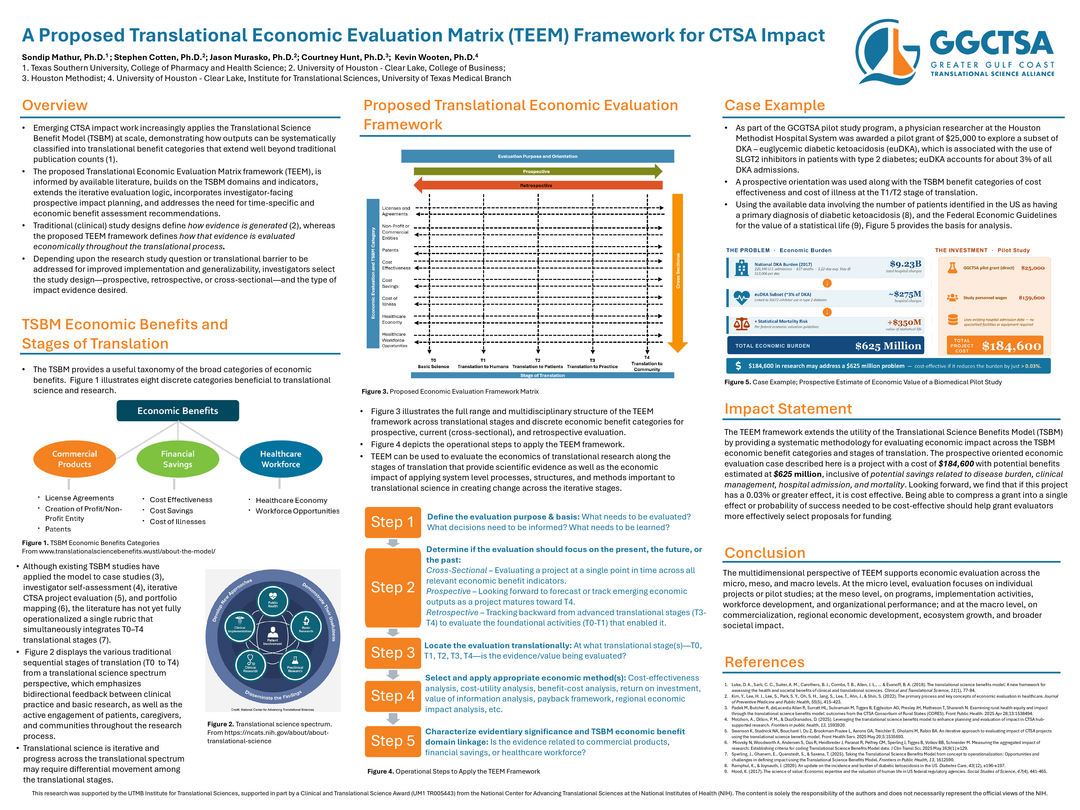
Emerging CTSA impact work increasingly applies the Translational Science Benefit Model (TSBM) at scale, demonstrating how outputs can be systematically classified into translational benefit categories that extend beyond traditional publication counts (Luke et al.,2018). A Translational Economic Evaluation Matrix (TEEM) framework is presented, described, and applied to a real case (CTSA research pilot funding) which is informed by available economic evaluation literature, builds on the TSBM domains and indicators, extends the iterative evaluation logic, incorporates investigator-facing prospective impact planning, and addresses the need for time-specific and economic benefit assessment recommendations.
The eight specific economic benefits proposed by the TSBM are reviewed, as well as the iterative nature of the stages of translation. The TEEM framework, which incorporates the use of the eight TSBM economic categories, the stages of translation (T0-T4), as well as temporal evaluation orientations involving prospective, cross- sectional, and retrospective designs, is presented. Five operational steps to applying the framework are reviewed: 1) defining the evaluation purpose; 2) establishing the evaluation’s (temporal) orientation(s) to support; 3) locating the evaluation translationally; 4) selecting and applying appropriate economic method(s) (e.g., cost utility, return on investment, regional economic impact analysis, etc.); and 5) characterizing evidentiary significance and TSBM domain linkage.
A prospectively oriented case is presented using a funded research pilot investigating euglycemic diabetic ketoacidosis (euDKA) and the cost associated with hospitalization and morbidity. The case displays the potential impact of utilizing positive findings from the pilot study involving the TSBM categories of research study cost effectiveness and reduced cost of illness and mortality. It is suggested that the proposed TEEM framework can be useful to CTSA evaluators and administrators in evaluating translational assets for which scientific, operational, economic, and societal value mature over time.
The eight specific economic benefits proposed by the TSBM are reviewed, as well as the iterative nature of the stages of translation. The TEEM framework, which incorporates the use of the eight TSBM economic categories, the stages of translation (T0-T4), as well as temporal evaluation orientations involving prospective, cross- sectional, and retrospective designs, is presented. Five operational steps to applying the framework are reviewed: 1) defining the evaluation purpose; 2) establishing the evaluation’s (temporal) orientation(s) to support; 3) locating the evaluation translationally; 4) selecting and applying appropriate economic method(s) (e.g., cost utility, return on investment, regional economic impact analysis, etc.); and 5) characterizing evidentiary significance and TSBM domain linkage.
A prospectively oriented case is presented using a funded research pilot investigating euglycemic diabetic ketoacidosis (euDKA) and the cost associated with hospitalization and morbidity. The case displays the potential impact of utilizing positive findings from the pilot study involving the TSBM categories of research study cost effectiveness and reduced cost of illness and mortality. It is suggested that the proposed TEEM framework can be useful to CTSA evaluators and administrators in evaluating translational assets for which scientific, operational, economic, and societal value mature over time.
Authors
First Author
Sondip Mathur, PhD
Contributing Authors
Stephen Cotten, PhD
Jason Murasko, PhD
Courtney Hunt, PhD
Kevin Wooten, PhD
Tags
economic evaluation
translational science impact
economic evaluation framework
Poster