Log in to view meeting materials such as meeting slides and recordings
2026 Fall CTSA Program Annual Meeting

2026 Fall CTSA Program
Annual Meeting
START to System Change: Using the Translational Science Benefits Model to Trace Clinical and Translational Impact of an Inpatient Addiction Consult Service Model
Hub not available
Abstract
Page K, Willging C, Adsul P, Koch B, Summers P, Smith C, Huerta S, Tigges B
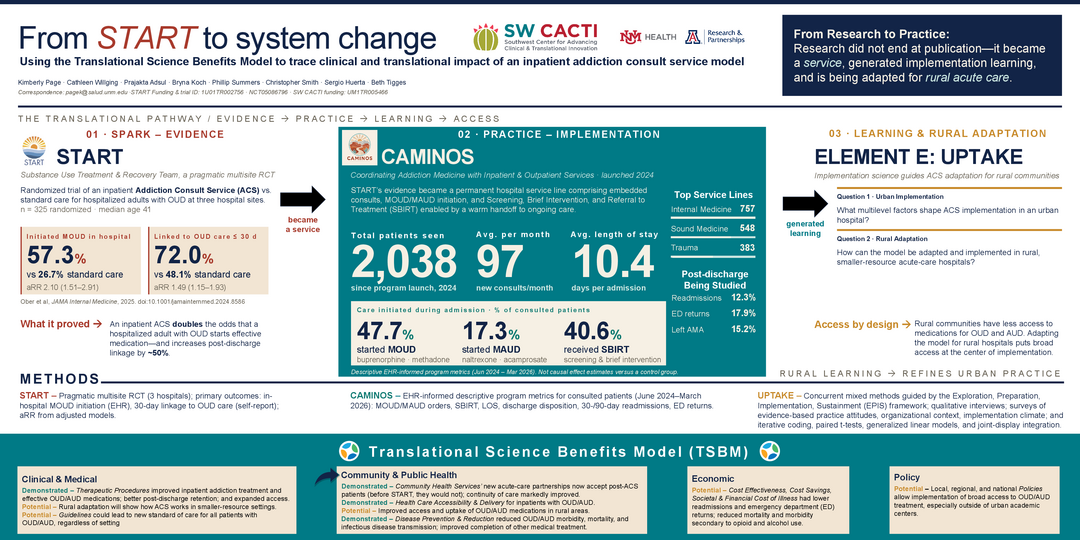
Objectives/Goals: Evidence-based interventions for hospitalized patients with opioid use disorder (OUD) rarely translate into sustained clinical services. We describe the translation of an inpatient addiction consult service (ACS) for this population from a multisite randomized trial into a permanent hospital service line at an urban hospital in the Southwest United States, followed by adaptation for rural acute care settings. We apply the Translational Science Benefits Model (TSBM) to characterize its impacts.
Methods/Study Population: The START trial (NCT05086796) randomized 325 hospitalized adults with OUD at three hospitals to a collaborative care-based inpatient addiction consult service (ACS; n=164) or standard of care (SOC; n=161); median age was 41 years. Outcomes were initiation of medication for OUD (MOUD) during hospitalization (electronic medical record [EHR]) and linkage to OUD treatment within 30 days of discharge (self-report). Trial findings informed the launch of “Coordinating Addiction Medicine with Inpatient and Outpatient Services” (CAMINOS), a permanent ACS expanded to also address unmet treatment needs related to alcohol use disorder (AUD) at the urban academic hospital. CAMINOS is now being evaluated using concurrent mixed methods guided by the Exploration, Preparation, Implementation, Sustainment (EPIS) framework, with data from key-informant interviews, quantitative surveys, and EHR-derived service metrics, integrated through joint displays.
Results: START participants were more likely than SOC participants to initiate MOUD during hospitalization (57.3% vs 26.7%; adjusted risk ratio [aRR] 2.10, 97.5%CI 1.51–2.91) and to link to OUD care after discharge (72.0% vs 48.1%; aRR 1.49, 97.5%CI 1.15–1.93). Since 2024, CAMINOS has served 2,083 patients (mean 97/month; mean length of stay 10.4 days); 47.7% initiated MOUD and 17.3% initiated treatment for alcohol use disorder. Readmission was 12.3%, post-discharge emergency department use 17.9%, and 15.2% left against medical advice; mixed methods analysis of CAMINOS implementation for OUD and AUD is underway.
Discussion/Significance of Impact: Across TSBM domains, translation of the ACS model from trial to permanent service line yielded demonstrated clinical, community and public health, and potential economic and policy benefits. Demonstrated impact included expanded access to medications for OUD and AUD, improved post-discharge retention, and new partnerships with post-acute facilities that previously declined these patients. Ongoing adaptation in rural acute care hospitals, where access to these medications is disproportionately low, will extend these gains, with potential for new clinical guidelines and supportive policies, documented disease prevention and reduction, improved cost-effectiveness and cost savings, and decreased societal and financial costs associated with OUD and AUD.
Objectives/Goals: Evidence-based interventions for hospitalized patients with opioid use disorder (OUD) rarely translate into sustained clinical services. We describe the translation of an inpatient addiction consult service (ACS) for this population from a multisite randomized trial into a permanent hospital service line at an urban hospital in the Southwest United States, followed by adaptation for rural acute care settings. We apply the Translational Science Benefits Model (TSBM) to characterize its impacts.
Methods/Study Population: The START trial (NCT05086796) randomized 325 hospitalized adults with OUD at three hospitals to a collaborative care-based inpatient addiction consult service (ACS; n=164) or standard of care (SOC; n=161); median age was 41 years. Outcomes were initiation of medication for OUD (MOUD) during hospitalization (electronic medical record [EHR]) and linkage to OUD treatment within 30 days of discharge (self-report). Trial findings informed the launch of “Coordinating Addiction Medicine with Inpatient and Outpatient Services” (CAMINOS), a permanent ACS expanded to also address unmet treatment needs related to alcohol use disorder (AUD) at the urban academic hospital. CAMINOS is now being evaluated using concurrent mixed methods guided by the Exploration, Preparation, Implementation, Sustainment (EPIS) framework, with data from key-informant interviews, quantitative surveys, and EHR-derived service metrics, integrated through joint displays.
Results: START participants were more likely than SOC participants to initiate MOUD during hospitalization (57.3% vs 26.7%; adjusted risk ratio [aRR] 2.10, 97.5%CI 1.51–2.91) and to link to OUD care after discharge (72.0% vs 48.1%; aRR 1.49, 97.5%CI 1.15–1.93). Since 2024, CAMINOS has served 2,083 patients (mean 97/month; mean length of stay 10.4 days); 47.7% initiated MOUD and 17.3% initiated treatment for alcohol use disorder. Readmission was 12.3%, post-discharge emergency department use 17.9%, and 15.2% left against medical advice; mixed methods analysis of CAMINOS implementation for OUD and AUD is underway.
Discussion/Significance of Impact: Across TSBM domains, translation of the ACS model from trial to permanent service line yielded demonstrated clinical, community and public health, and potential economic and policy benefits. Demonstrated impact included expanded access to medications for OUD and AUD, improved post-discharge retention, and new partnerships with post-acute facilities that previously declined these patients. Ongoing adaptation in rural acute care hospitals, where access to these medications is disproportionately low, will extend these gains, with potential for new clinical guidelines and supportive policies, documented disease prevention and reduction, improved cost-effectiveness and cost savings, and decreased societal and financial costs associated with OUD and AUD.
Authors
First Author
Kim Page, PhD, MPH, MS
Contributing Authors
Cathleen Willging, PhD
Prajakta Adsul, MBBS, MPH, PhD
Bryna Koch, DrPH
Phillip Summers, MD, MPH
Christopher Smith, MD
Sergio Huerta, MD
Beth Tigges, PhD
Poster