Log in to view meeting materials such as meeting slides and recordings
2026 Fall CTSA Program Annual Meeting

2026 Fall CTSA Program
Annual Meeting
A Study to Help Newborns Suffering from Opioid Withdrawal Informed Changes in Neonatal Research
Hub not available
Abstract
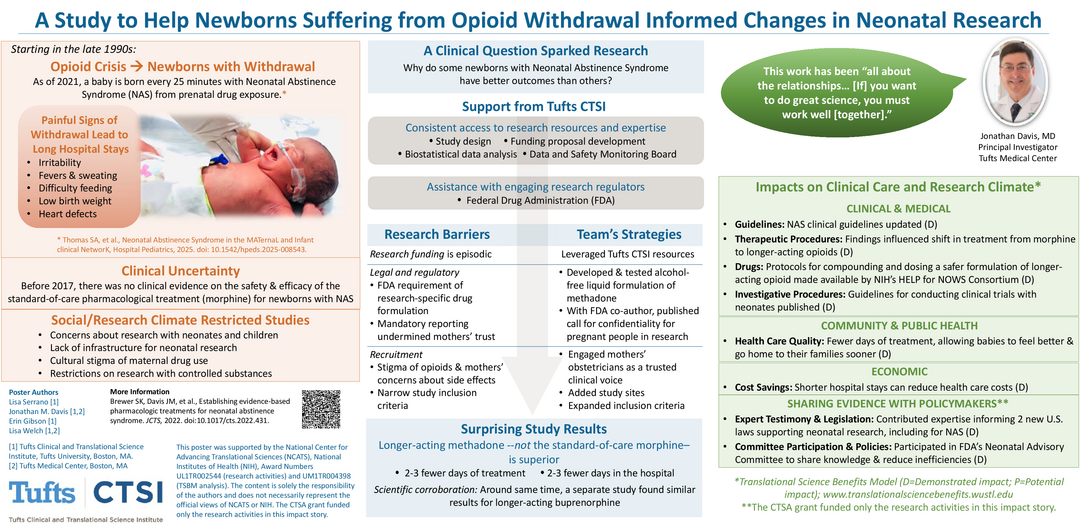
Starting in the late 1990s, a growing number of newborns are exposed to addictive drugs before birth--usually a prescription pain killer, heroin, or fentanyl--and begin withdrawal after delivery. Newborns with this condition, neonatal abstinence syndrome (NAS), have a range of signs of withdrawal and can stay in the hospital for weeks. As of 2021, more than one newborn developed NAS every 25 minutes (1).
Until 2017, there was no research on which medicines best treat NAS. Clinicians were using drugs created for adults and estimating the doses for neonates.
In 2012, Dr. Jon Davis and a team at Tufts Medical Center led the first large study with newborns to compare the most used drug treatment (morphine) to a longer-acting medicine (methadone). They faced many obstacles--legal barriers to studies with controlled substances; difficulty recruiting mothers due to stigma, legal fears, drug side effects, and narrow inclusion criteria; and social and regulatory concerns about research risks to babies.
Tufts Clinical and Translational Science Institute (CTSI) helped make this study possible. Biostatisticians carefully designed and redesigned the protocol to receive NIH funding for a multi-site study and expertly analyzed complex data. Tufts CTSI also provided a Data & Safety Monitoring Board and assisted Dr. Davis in engaging regulators to address research obstacles.
Study results were surprising. The longer-acting medicine (methadone), not the standard of care (morphine), led to fewer days of treatment and shorter hospital stays. Around the same time, another study corroborated these findings with a similar longer-acting medicine (buprenorphine).
Based on these results, the American Academy of Pediatrics published new guidelines recommending that the longer-acting medicines be used to shorten treatment length and hospital stays, which can lower health care costs. Protocols for compounding a safer drug formulation and symptom-based dosing also became available.
Just as important, the research helped improve the environment for studying treatments for newborns. Dr. Davis worked with regulators and legislators to ensure treatments for newborns are shown to be safe and effective, including the Protecting our Infants Act of 2015 and requiring that the Food and Drug Administration (FDA) have experts in newborn medicine (2). He joined FDA committees and worked with national and international partners to develop best practices for neonatal research.
This study influenced NAS treatment--reducing patient suffering, family burden, and hospital costs--and strengthened the climate for research with newborns. What began as a question about treating newborns with NAS at one hospital grew into a national effort to improve care for some of the smallest and most vulnerable patients.
1Thomas SA, et al., Neonatal Abstinence Syndrome in the MATernaL and Infant clinical NetworK, Hosp Pediatr, 2025.
2The CTSI grant funded only the research activities in this impact story.
Until 2017, there was no research on which medicines best treat NAS. Clinicians were using drugs created for adults and estimating the doses for neonates.
In 2012, Dr. Jon Davis and a team at Tufts Medical Center led the first large study with newborns to compare the most used drug treatment (morphine) to a longer-acting medicine (methadone). They faced many obstacles--legal barriers to studies with controlled substances; difficulty recruiting mothers due to stigma, legal fears, drug side effects, and narrow inclusion criteria; and social and regulatory concerns about research risks to babies.
Tufts Clinical and Translational Science Institute (CTSI) helped make this study possible. Biostatisticians carefully designed and redesigned the protocol to receive NIH funding for a multi-site study and expertly analyzed complex data. Tufts CTSI also provided a Data & Safety Monitoring Board and assisted Dr. Davis in engaging regulators to address research obstacles.
Study results were surprising. The longer-acting medicine (methadone), not the standard of care (morphine), led to fewer days of treatment and shorter hospital stays. Around the same time, another study corroborated these findings with a similar longer-acting medicine (buprenorphine).
Based on these results, the American Academy of Pediatrics published new guidelines recommending that the longer-acting medicines be used to shorten treatment length and hospital stays, which can lower health care costs. Protocols for compounding a safer drug formulation and symptom-based dosing also became available.
Just as important, the research helped improve the environment for studying treatments for newborns. Dr. Davis worked with regulators and legislators to ensure treatments for newborns are shown to be safe and effective, including the Protecting our Infants Act of 2015 and requiring that the Food and Drug Administration (FDA) have experts in newborn medicine (2). He joined FDA committees and worked with national and international partners to develop best practices for neonatal research.
This study influenced NAS treatment--reducing patient suffering, family burden, and hospital costs--and strengthened the climate for research with newborns. What began as a question about treating newborns with NAS at one hospital grew into a national effort to improve care for some of the smallest and most vulnerable patients.
1Thomas SA, et al., Neonatal Abstinence Syndrome in the MATernaL and Infant clinical NetworK, Hosp Pediatr, 2025.
2The CTSI grant funded only the research activities in this impact story.
Authors
First Author
Lisa Serrano, MS, RD, PMP
Contributing Authors
Jonathan Davis, MD
Erin Gibson, MPH
Lisa C. Welch, PhD
Tags
Neonatal abstinence syndrome
Newborn and pediatric research
Addiction and withdrawal
Clinical guidelines
Team science
Poster