Log in to view meeting materials such as meeting slides and recordings
2026 Fall CTSA Program Annual Meeting

2026 Fall CTSA Program
Annual Meeting
20 Years and Beyond: How OCTRI has advanced -and will continue to advance- community and clinical benefits through cross-program collaboration
Hub not available
Abstract
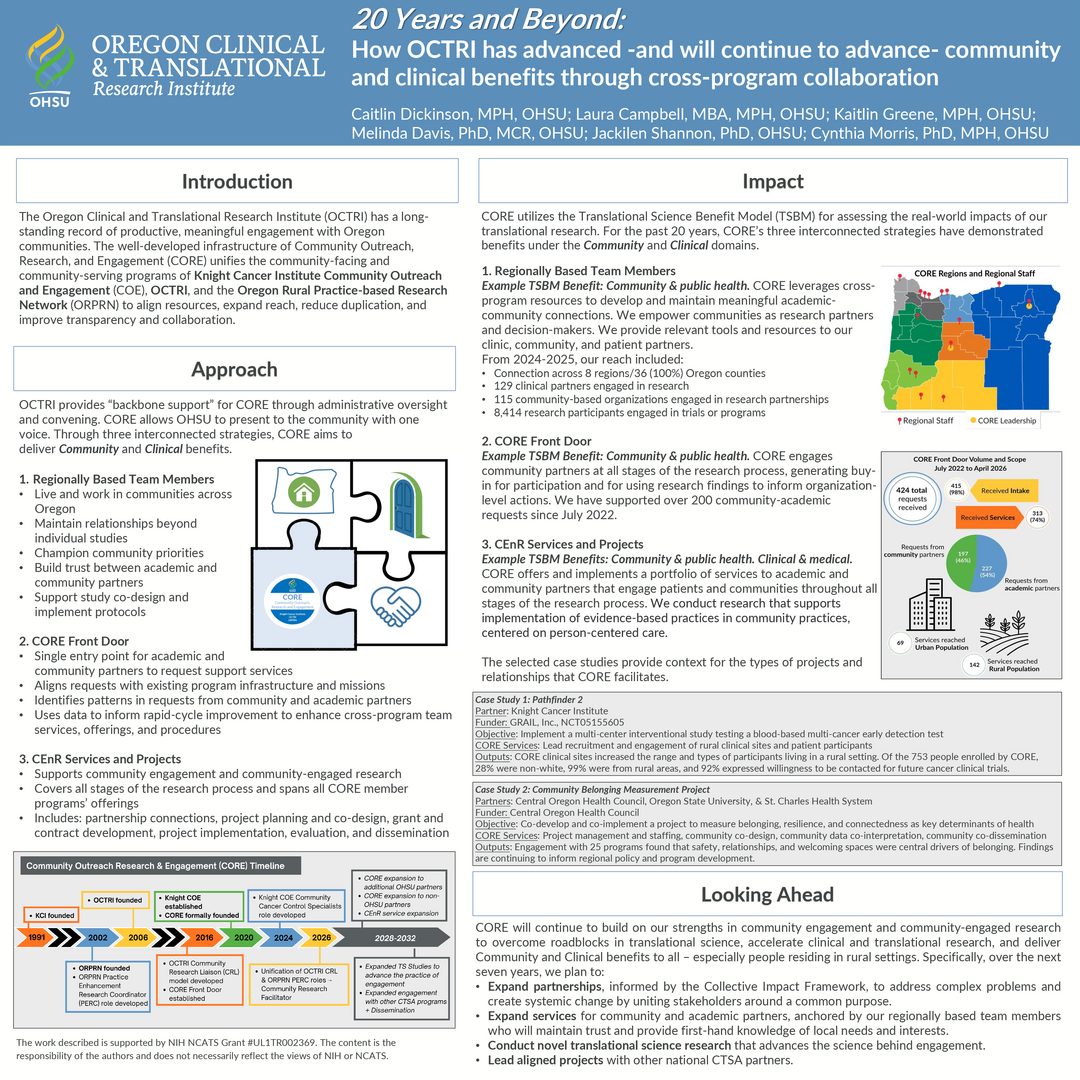
Introduction: The Oregon Clinical and Translational Research Institute (OCTRI) has a long-standing record of productive, meaningful engagement with Oregon communities. The well-developed Community Outreach, Research, and Engagement (CORE) infrastructure unifies the community-facing and community-serving programs of the Knight Cancer Institute Community Outreach and Engagement (COE), OCTRI, and the Oregon Rural Practice-based Research Network (ORPRN).
Approach: OCTRI provides “backbone support” for CORE through administrative oversight and convening.
1. Regionally Based Team Members- CORE funds Community Research Facilitators (CRFs) who live and work in communities across Oregon. CRFs maintain relationships beyond individual studies and facilitate community engagement in research. They champion community priorities; build trust between academic and community partners; support study co-design; and implement protocols.
2. Front Door- CORE Front Door is the single-entry point for academic and community partners to request support services. It strengthens OHSU’s ability to coordinate how it receives, responds to, tracks, and supports community-engaged research partnerships.
3. CEnR Services and Projects- Services provided by CORE member organizations support community engagement and community-engaged research and may include partnership connections, project planning and co-design, grant and contract development, project implementation, evaluation, and dissemination. Services and support cover all stages of the research process and span all CORE member programs’ offerings.
Impact: CORE uses the Translational Science Benefit Model (TSBM) to assess the real-world impacts of our translational research.
1. Regionally Based Team Members- Community and public health. CORE leverages cross-program resources to develop and maintain meaningful academic-community connections. We empower communities as research partners and decision-makers. We provide relevant tools and resources to our clinic, community, and patient partners.
2. CORE Front Door- Community & public health. CORE engages community partners at all stages of the research process, generating buy-in for participation and for using research findings to inform organization-level actions.
3. CEnR Services and Projects- Community and public health. Clinical and medical. CORE offers and implements a portfolio of services for academic and community partners that engage patients and communities throughout all stages of the research process. We conduct research that supports implementing evidence-based practices in community settings, centered on person-centered care.
Looking Ahead: CORE will continue to build on our strengths in community engagement and community-engaged research to overcome roadblocks in translational science, accelerate clinical and translational research, and deliver Community and Clinical benefits to all – especially people residing in rural settings.
Approach: OCTRI provides “backbone support” for CORE through administrative oversight and convening.
1. Regionally Based Team Members- CORE funds Community Research Facilitators (CRFs) who live and work in communities across Oregon. CRFs maintain relationships beyond individual studies and facilitate community engagement in research. They champion community priorities; build trust between academic and community partners; support study co-design; and implement protocols.
2. Front Door- CORE Front Door is the single-entry point for academic and community partners to request support services. It strengthens OHSU’s ability to coordinate how it receives, responds to, tracks, and supports community-engaged research partnerships.
3. CEnR Services and Projects- Services provided by CORE member organizations support community engagement and community-engaged research and may include partnership connections, project planning and co-design, grant and contract development, project implementation, evaluation, and dissemination. Services and support cover all stages of the research process and span all CORE member programs’ offerings.
Impact: CORE uses the Translational Science Benefit Model (TSBM) to assess the real-world impacts of our translational research.
1. Regionally Based Team Members- Community and public health. CORE leverages cross-program resources to develop and maintain meaningful academic-community connections. We empower communities as research partners and decision-makers. We provide relevant tools and resources to our clinic, community, and patient partners.
2. CORE Front Door- Community & public health. CORE engages community partners at all stages of the research process, generating buy-in for participation and for using research findings to inform organization-level actions.
3. CEnR Services and Projects- Community and public health. Clinical and medical. CORE offers and implements a portfolio of services for academic and community partners that engage patients and communities throughout all stages of the research process. We conduct research that supports implementing evidence-based practices in community settings, centered on person-centered care.
Looking Ahead: CORE will continue to build on our strengths in community engagement and community-engaged research to overcome roadblocks in translational science, accelerate clinical and translational research, and deliver Community and Clinical benefits to all – especially people residing in rural settings.
Authors
First Author
Caitlin Dickinson, MPH
Contributing Authors
Laura Campbell, MBA, MPH
Kaitlin Greene, MPH
Melinda Davis, PhD, MCR
Jackilen Shannon, PhD
Cynthia Morris, PhD, MPH
Poster