Log in to view meeting materials such as meeting slides and recordings
2026 Fall CTSA Program Annual Meeting

2026 Fall CTSA Program
Annual Meeting
From Discovery to Policy Guidance: 20 Years of CTSA Research Shaping Evidence-Based Clinical Guidelines
Hub not available
Abstract
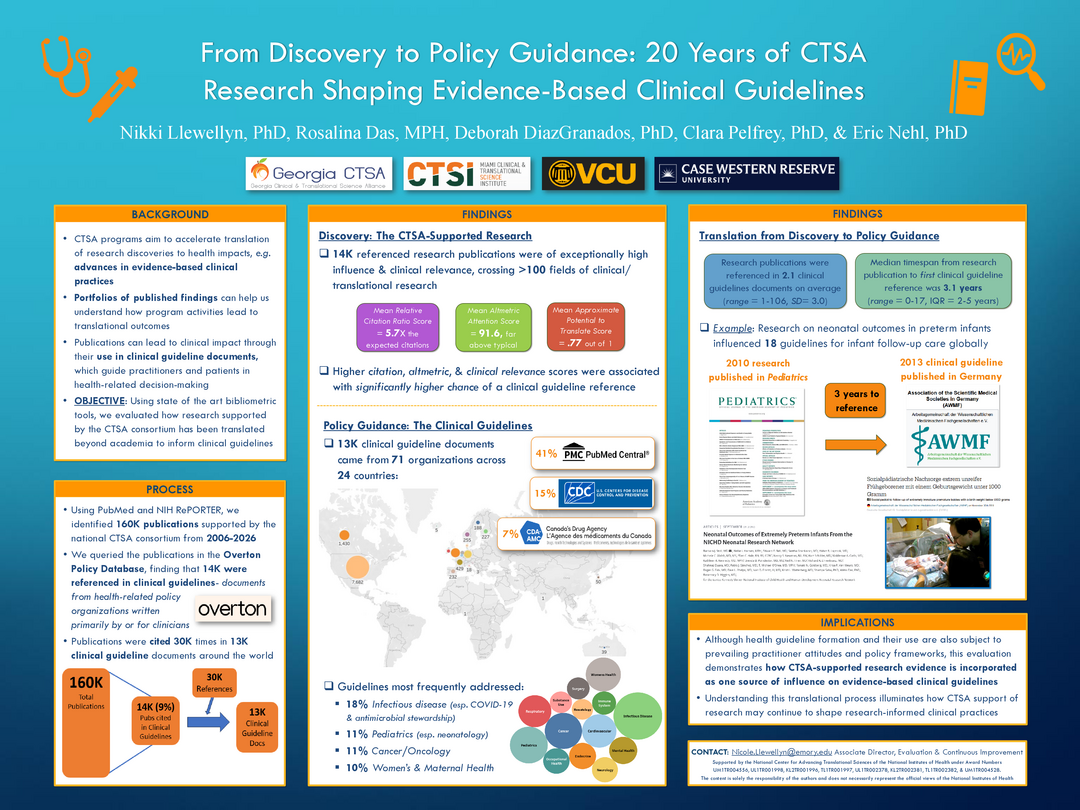
Background: The NIH’s Clinical and Translational Science Awards (CTSA) consortium aims to accelerate the translation of research discoveries into health impacts, such as advances in evidence-based clinical practices. Portfolios of published findings can help us understand how program activities lead to translational outcomes. These publications can lead to clinical impact through their use in clinical guideline documents, which advise practitioners and patients in health-related decision-making. Using state-of-the-art bibliometrics, we evaluated how research supported by the CTSA program has been translated beyond academic boundaries to inform clinical guideline formulation.
Process: Using PubMed and NIH RePORTER, we identified 160K publications supported by the CTSA consortium from 2006 to 2026. We queried those publications in the Overton Policy Database, for references in clinical guidelines documents, which are written primarily by or for clinicians from health-related policy organizations. We evaluated content and characteristics for both the referenced CTSA-supported research and the referencing clinical guidelines documents.
Findings: Approximately 14K (9%) CTSA-supported publications were referenced in clinical guidelines. Research with higher academic influence, public attention, and clinical relevance was significantly more likely to be referenced in a clinical guideline. Those publications were referenced 30K times in 13K different clinical guideline documents authored by 71 organizations across 24 countries. The most frequent outlets were Guidelines in Pubmed Central, the Centers for Disease Control and Prevention, and other national health agencies around the world. Referencing clinical guidelines were most often comprised of evidence syntheses on the topics of Infectious Diseases (esp COVID-19 & antimicrobial stewardship), Pediatrics/ Neonatology, Cancer/Oncology, and Women’s & Maternal/Fetal Health. Research publications were referenced in 2.1 clinical guidelines on average (range = 1-106, SD = 3)), and the interval from publication to its first clinical guideline reference was 3.1 years on average (range = 0-17, IQR = 2-5 years).
Implications: Although health guideline formation and their use are also subject to prevailing practitioner attitudes and policy frameworks, this evaluation demonstrates how CTSA-supported research evidence is incorporated as one source of influence on evidence-based clinical guidelines. Understanding this translational process illuminates how continuing CTSA support of research may shape future research-informed clinical practices.
Authors
First Author
Nikki Llewellyn, PhD
Contributing Authors
Nikki Llewellyn, PhD
Roslina Das, MPH
Deborah DiazGranados, PhD
Clara Pelfrey, PHD
Eric Nehl, PhD
Tags
Clinical guidelines
Evidence-based policy
Bibliometrics
Overton
Multi-Hub Evaluation
Poster