Log in to view meeting materials such as meeting slides and recordings
2026 Fall CTSA Program Annual Meeting

2026 Fall CTSA Program
Annual Meeting
Advancing Translational Science Through Regulatory Infrastructure, Workforce Development, and National Collaboration: Twenty Years of CTSA Impact at Duke University
Hub not available
Abstract
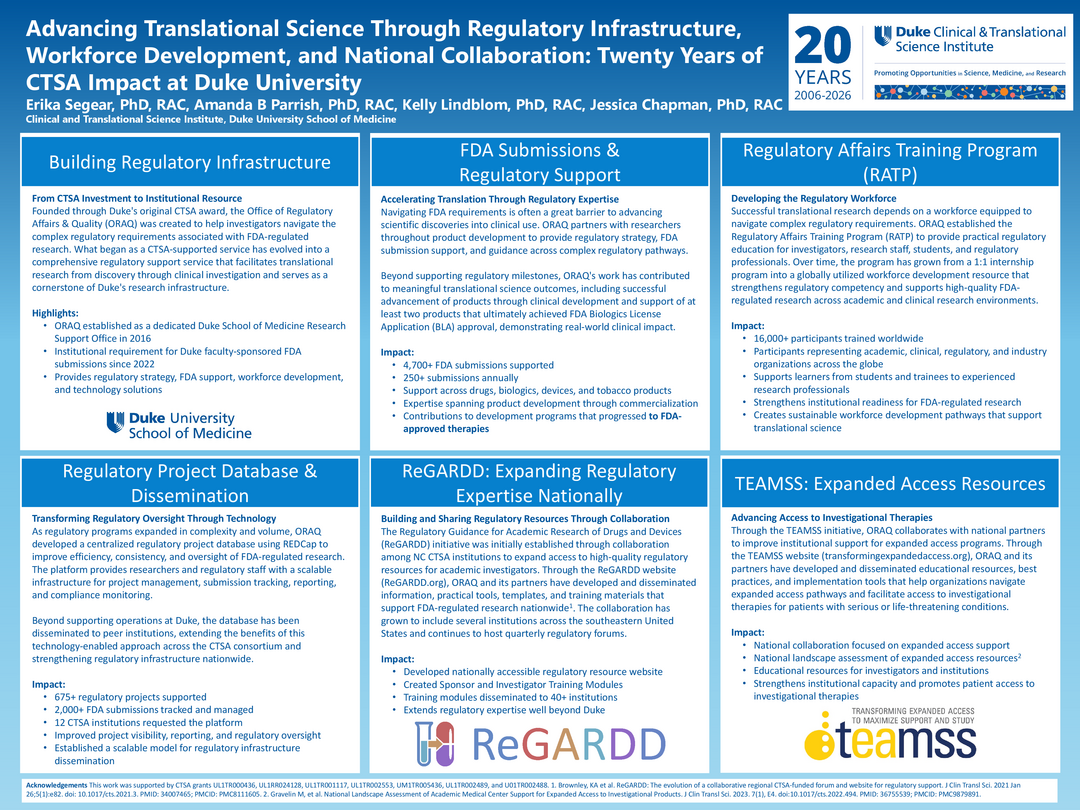
Successful translation of scientific discoveries into medical products requires regulatory expertise, infrastructure, and workforce development. Recognizing the challenges academic investigators face in navigating FDA requirements, Duke University leveraged support from the Clinical and Translational Science Award (CTSA) Program to establish regulatory affairs resources that accelerate translational research.
What began as a CTSA-supported service evolved into a comprehensive regulatory ecosystem that now serves as a cornerstone of Duke's translational research enterprise. Duke institutionalized these efforts through creation of the Office of Regulatory Affairs & Quality (ORAQ) in 2016 and further integrated regulatory support into its research infrastructure by requiring ORAQ engagement for Duke-sponsored FDA-regulated submissions in 2022. This progression illustrates how CTSA-supported innovation can create sustainable institutional capacity.
ORAQ provides regulatory strategy, FDA submission support, workforce development, and technology-enabled solutions that advance translational research from discovery through clinical investigation. Since its inception, ORAQ has supported more than 4,700 FDA submissions, averaging over 250 annually. To improve efficiency, oversight, and compliance, ORAQ developed a centralized regulatory project database that has supported more than 675 projects and facilitated management of over 2,000 FDA submissions. The database has also been shared with 12 CTSA institutions, extending its impact across the consortium.
To strengthen the regulatory workforce, ORAQ established the Regulatory Affairs Training Program (RATP), which has trained more than 16,000 participants worldwide. ORAQ also developed Sponsor and Investigator Training Modules, which have trained 172 Duke faculty and 497 staff and have been distributed to more than 40 institutions. These programs expand regulatory knowledge and promote best practices across the clinical research workforce.
ORAQ's impact extends nationally through the Regulatory Guidance for Academic Research of Drugs and Devices (ReGARDD) and Transforming Expanded Access to Maximize Support and Study (TEAMSS) initiatives. ReGARDD provides investigators with freely accessible regulatory resources, templates, and tools for FDA-regulated research, while TEAMSS develops best practices and educational resources to improve expanded access programs and patient access to investigational therapies. Together, these initiatives strengthen institutional capacity, expand regulatory expertise, and support more efficient translation of medical innovations into patient care.
As the CTSA Program marks 20 years of impact, ORAQ demonstrates how strategic investment in regulatory affairs can evolve from a grant-supported resource into a sustainable institutional asset that advances translational research, develops the workforce, enables clinical innovation, and amplifies impact far beyond a single institution.
What began as a CTSA-supported service evolved into a comprehensive regulatory ecosystem that now serves as a cornerstone of Duke's translational research enterprise. Duke institutionalized these efforts through creation of the Office of Regulatory Affairs & Quality (ORAQ) in 2016 and further integrated regulatory support into its research infrastructure by requiring ORAQ engagement for Duke-sponsored FDA-regulated submissions in 2022. This progression illustrates how CTSA-supported innovation can create sustainable institutional capacity.
ORAQ provides regulatory strategy, FDA submission support, workforce development, and technology-enabled solutions that advance translational research from discovery through clinical investigation. Since its inception, ORAQ has supported more than 4,700 FDA submissions, averaging over 250 annually. To improve efficiency, oversight, and compliance, ORAQ developed a centralized regulatory project database that has supported more than 675 projects and facilitated management of over 2,000 FDA submissions. The database has also been shared with 12 CTSA institutions, extending its impact across the consortium.
To strengthen the regulatory workforce, ORAQ established the Regulatory Affairs Training Program (RATP), which has trained more than 16,000 participants worldwide. ORAQ also developed Sponsor and Investigator Training Modules, which have trained 172 Duke faculty and 497 staff and have been distributed to more than 40 institutions. These programs expand regulatory knowledge and promote best practices across the clinical research workforce.
ORAQ's impact extends nationally through the Regulatory Guidance for Academic Research of Drugs and Devices (ReGARDD) and Transforming Expanded Access to Maximize Support and Study (TEAMSS) initiatives. ReGARDD provides investigators with freely accessible regulatory resources, templates, and tools for FDA-regulated research, while TEAMSS develops best practices and educational resources to improve expanded access programs and patient access to investigational therapies. Together, these initiatives strengthen institutional capacity, expand regulatory expertise, and support more efficient translation of medical innovations into patient care.
As the CTSA Program marks 20 years of impact, ORAQ demonstrates how strategic investment in regulatory affairs can evolve from a grant-supported resource into a sustainable institutional asset that advances translational research, develops the workforce, enables clinical innovation, and amplifies impact far beyond a single institution.
Authors
First Author
Erika Segear, PhD, RAC
Contributing Authors
Amanda Parrish, PhD, RAC
Kelly Lindblom, PhD, RAC
Jessica Chapman, PhD, RAC
Poster