Log in to view meeting materials such as meeting slides and recordings
2026 Fall CTSA Program Annual Meeting

2026 Fall CTSA Program
Annual Meeting
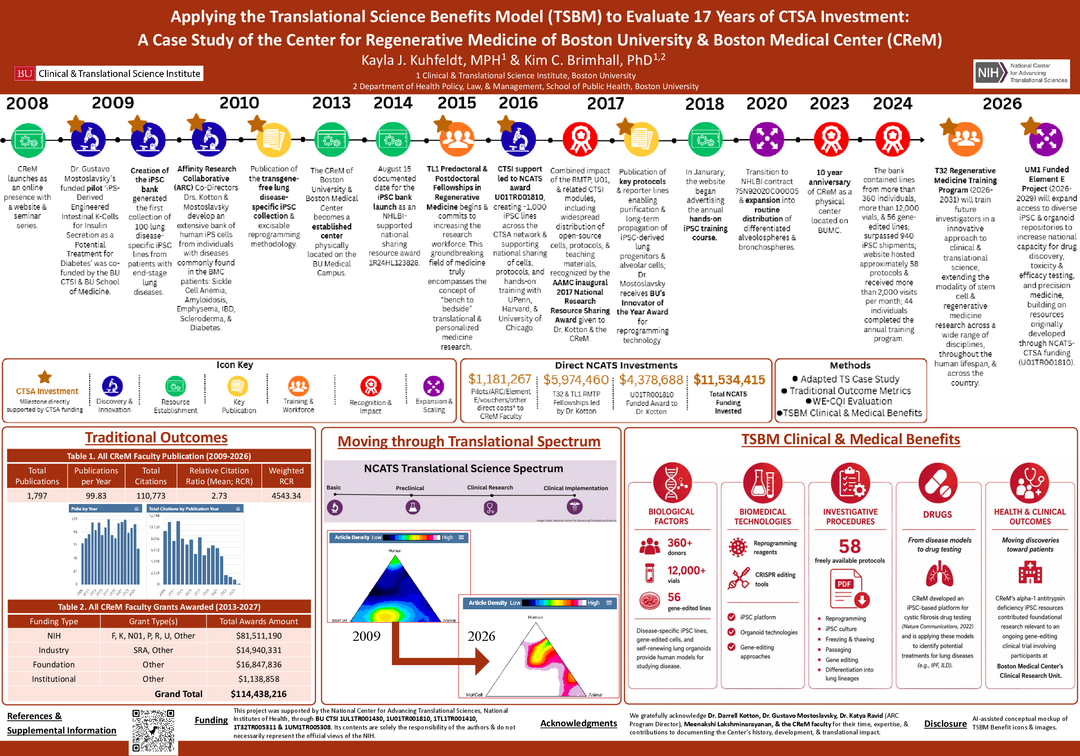
Applying the Translational Science Benefits Model (TSBM) to Evaluate 17 Years of CTSA Investment: A Case Study of the Center for Regenerative Medicine of Boston University & Boston Medical Center (CReM)
Hub not available
Abstract
Background: Clinical translation needs scientific discoveries with effective infrastructure, innovative technologies, and multidisciplinary collaborations that enable discoveries to progress toward improved patient care. The Translational Science Benefits Model (TSBM) provides a structured framework for evaluating these downstream impacts. We apply the Clinical & Medical domain of the TSBM to evaluate how Clinical and Translational Science Award (CTSA) investments catalyzed the development of the Center for Regenerative Medicine of Boston University & Boston Medical Center (CReM) and advanced regenerative medicine along the translational continuum.
Methods: An adapted translational science case study was conducted using institutional records, program documentation, publicly available reports and data, and historical milestones describing CReM's development. The evaluation mapped major CTSA-supported investments over time to the Clinical & Medical domain of the TSBM through the developmental pathway of CReM from its initial 2009 Boston University CTSI Pilot Award through the establishment of an Affinity Research Collaborative, institutional support as a university center, the CTSA-supported TL1 Training Program, and its subsequent growth as an internationally recognized regenerative medicine center.
To evaluate translational impact, identified milestones and outputs are systematically mapped to the Clinical & Medical domain of the TSBM, examining how CTSA-supported investments contributed to the development of disease models, regenerative medicine technologies, investigative procedures, and biological factors that advance clinical research and enable future improvements in patient care.
Results: CTSA investments supported the evolution of CReM from a pilot into an internationally recognized regenerative medicine center. Within the Clinical & Medical domain, these investments enabled the development and dissemination of induced pluripotent stem cell technologies, human disease models, organoid systems, gene editing approaches, and shared resources that improve investigators' ability to study disease mechanisms and evaluate therapeutic strategies. CTSA-supported infrastructure also fostered sustained collaboration among basic scientists, engineers, and clinician-investigators, accelerating translational research across multiple disease areas. The establishment of the TL1 Program further strengthened the clinical translational workforce by preparing investigators to move regenerative discoveries toward clinical application using interdisciplinary translational science competencies.
Conclusions: Rather than evaluating a single scientific breakthrough, this poster illustrates how sustained investments in research infrastructure, collaboration, and workforce development create the conditions necessary for future innovation. The CReM demonstrates how CTSA-supported ecosystems accelerate progress from discovery to improved clinical care.
Methods: An adapted translational science case study was conducted using institutional records, program documentation, publicly available reports and data, and historical milestones describing CReM's development. The evaluation mapped major CTSA-supported investments over time to the Clinical & Medical domain of the TSBM through the developmental pathway of CReM from its initial 2009 Boston University CTSI Pilot Award through the establishment of an Affinity Research Collaborative, institutional support as a university center, the CTSA-supported TL1 Training Program, and its subsequent growth as an internationally recognized regenerative medicine center.
To evaluate translational impact, identified milestones and outputs are systematically mapped to the Clinical & Medical domain of the TSBM, examining how CTSA-supported investments contributed to the development of disease models, regenerative medicine technologies, investigative procedures, and biological factors that advance clinical research and enable future improvements in patient care.
Results: CTSA investments supported the evolution of CReM from a pilot into an internationally recognized regenerative medicine center. Within the Clinical & Medical domain, these investments enabled the development and dissemination of induced pluripotent stem cell technologies, human disease models, organoid systems, gene editing approaches, and shared resources that improve investigators' ability to study disease mechanisms and evaluate therapeutic strategies. CTSA-supported infrastructure also fostered sustained collaboration among basic scientists, engineers, and clinician-investigators, accelerating translational research across multiple disease areas. The establishment of the TL1 Program further strengthened the clinical translational workforce by preparing investigators to move regenerative discoveries toward clinical application using interdisciplinary translational science competencies.
Conclusions: Rather than evaluating a single scientific breakthrough, this poster illustrates how sustained investments in research infrastructure, collaboration, and workforce development create the conditions necessary for future innovation. The CReM demonstrates how CTSA-supported ecosystems accelerate progress from discovery to improved clinical care.
Authors
First Author
Kayla Kuhfeldt, MPH
Contributing Authors
Kim Brimhall, PhD, CSW, MSW
Tags
Translational Science Benefits Model
CTSA Impact
Program Evaluation
Clinical & Medical Benefits
Regenerative Medicine
Poster