Log in to view meeting materials such as meeting slides and recordings
2026 Fall CTSA Program Annual Meeting

2026 Fall CTSA Program
Annual Meeting
From Local Tools to National Platforms: Two Decades of Translational Science Impact at the Harvard CTSA
Hub not available
Abstract
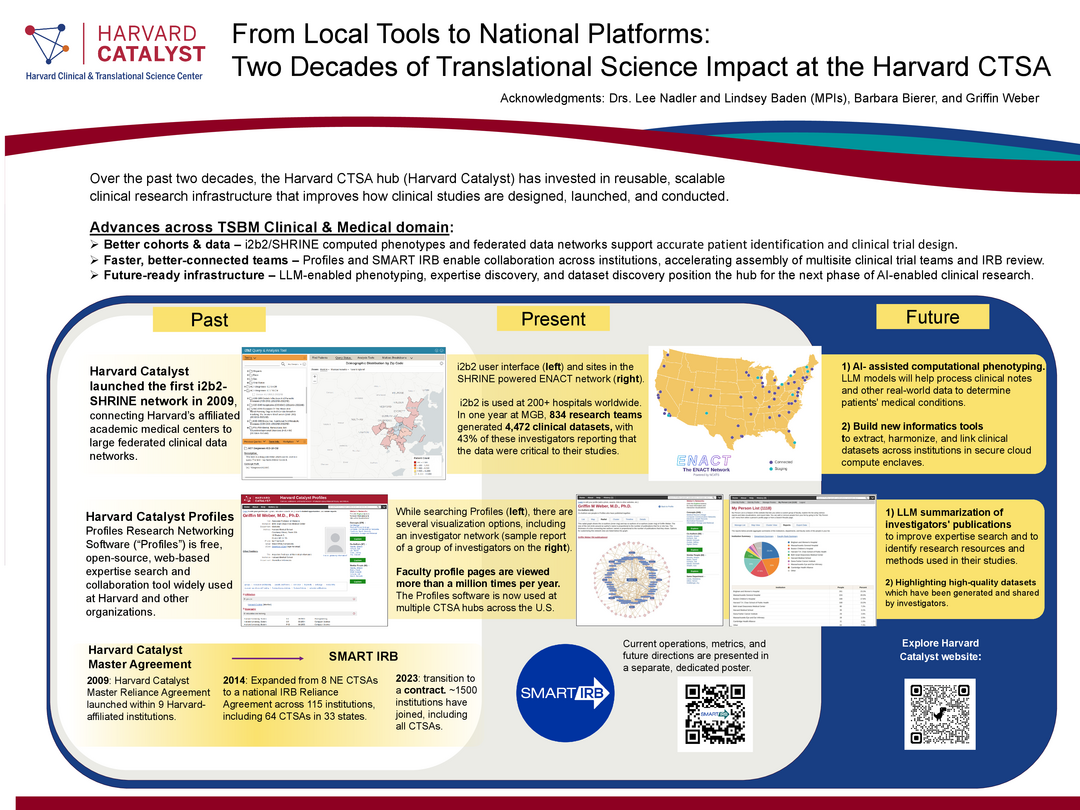
Clinical research can stall at three interconnected bottlenecks: identifying eligible patients, assembling effective multidisciplinary teams, and launching multisite studies efficiently. Over the past two decades, the Harvard CTSA hub (Harvard Catalyst) has addressed these challenges by developing shared, scalable clinical research infrastructure that evolved from local innovations into widely adopted, national platforms. This poster traces that trajectory and highlights its impact within the Clinical & Medical domain of the Translational Science Benefits Model.
In 2009, Harvard Catalyst launched the first i2b2-SHRINE network, connecting affiliated academic medical centers through federated clinical data infrastructure. i2b2 integrates electronic health record, clinical trial, and genomic data, while SHRINE enables secure federated queries across institutions. The platforms support computed phenotypes, cohort discovery, study feasibility assessment, patient identification, and clinical trial design. i2b2 is now used at more than 200 hospitals worldwide. At Mass General Brigham alone, 834 research teams generated 4,472 clinical datasets in a single year; 43% reported that these data were critical to their studies. The SHRINE-powered EnACT network connects dozens of CTSA hubs and provides access to EHR data of more than 100 million individuals.
Harvard Catalyst developed Profiles Research Networking Software, a free, open-source platform that integrates institutional information with publications, grants, clinical trials, and other scholarly activities to facilitate expertise discovery and collaboration. At Harvard, our Profiles website, which includes 24,000 faculty and trainees, is viewed more than one million times annually. The Profiles software has also been adopted across multiple CTSA hubs, enabling investigators to identify collaborators, assemble multidisciplinary teams, and locate specialized research resources.
Harvard Catalyst also developed the IRB Reliance Agreement that evolved into SMART IRB. Initially established in 2009 among nine Harvard-affiliated institutions, the agreement expanded nationally and, by 2023, supported approximately 1,500 participating institutions, including all CTSA hubs. SMART IRB illustrates how locally developed governance infrastructure can reduce regulatory barriers and accelerate multisite research.
Collectively, these initiatives have generated measurable benefits across the clinical research lifecycle, enabling more precise cohort identification, stronger collaborative networks, and more efficient study activation. Harvard Catalyst is now extending this foundation through large-language-model-enabled phenotyping, cross-institutional data harmonization, investigator and dataset discovery, and other innovations. The resulting impact is a durable clinical research ecosystem that improves how studies are designed, launched, and conducted while supporting broader, more inclusive participation in research.
Authors
First Author
Griffin Weber, MD, PhD
Contributing Authors
Barbara Bierer, MD
Tags
Computed Phenotyping
Multisite Clinical Research
Profiles
i2b2/SHRINE
SMART IRB
Poster