Log in to view meeting materials such as meeting slides and recordings
2025 Fall CTSA Program Annual Meeting

2025 Fall CTSA Program
Annual Meeting
Building a Digital Twin Model for Predicting Maternal Health Risks: Utilizing Multi-Institutional Collaborations to Advance Innovative Clinical and Translational Science
Hub not available
Abstract
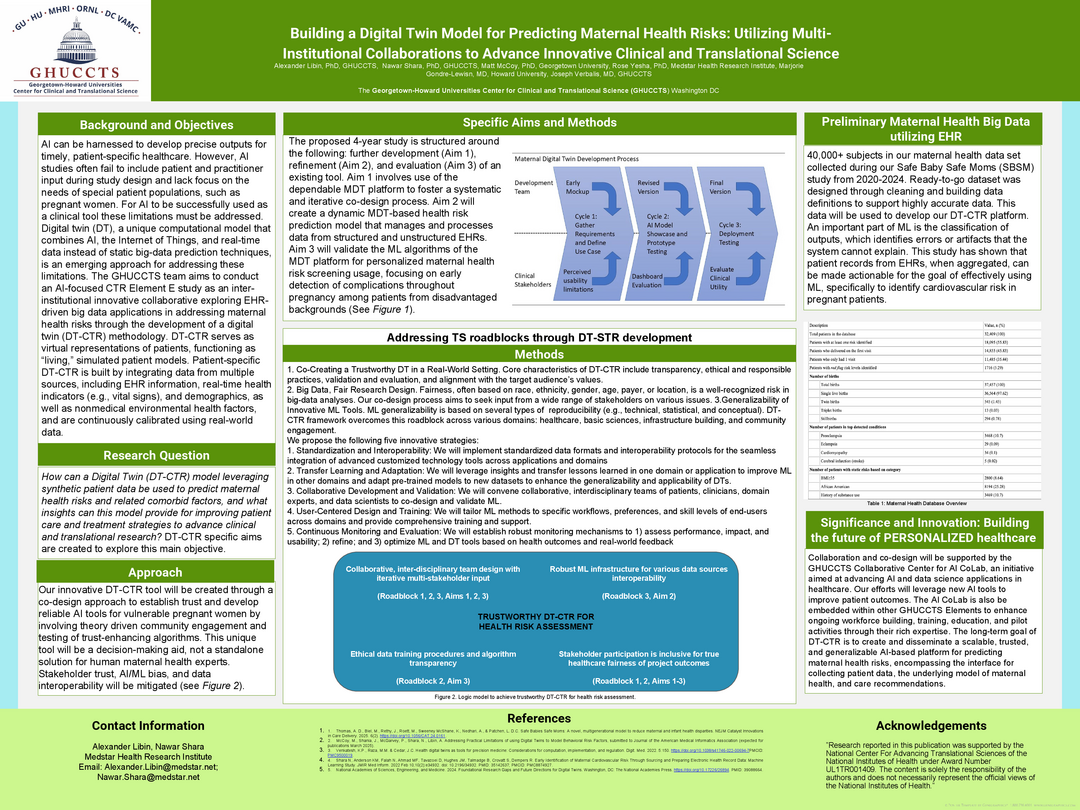
Artificial Intelligence (AI) holds significant promise for developing personalized predictions patient-specific healthcare. However, AI studies often fail to integrate the needs of special patient populations, including pregnant women. Digital twin (DT) technology represents an emerging approach for addressing these limitations while optimizing healthcare decisions. The GHUCCTS team aims to conduct an AI-focused Clinical and Translational Research (CTR)Element E study as an inter-institutional innovative collaborative exploring EHR-driven big data applications in addressing maternal health risks through the development of a digital twin (DT-CTR) methodology. DT-CTR serves as virtual representations of patients, functioning as “living,” simulated patient models. Patient-specific DT-CTR is built by integrating data from multiple sources, including EHR information, real-time health indicators (e.g., vital signs), and demographics, as well as nonmedical environmental health factors, which are continuously calibrated using real-world data. Research Question and related Specific Aims: How can a Digital Twin (DT-CTR) model leverage synthetic patient data for predicting maternal health risks and related comorbid factors? DR-CRT specific aims are structured around a proposed 4-year study which emphasizes Aim 1 (further development), Aim 2 (refinement), and Aim 3 (evaluation of an existing tool). Aim 1 will optimize the Maternal Digital Twin (MDT) platform via a iterative process that includes diverse stakeholders. Aim 2 will create adynamic MDT-based health risk prediction model that utilizes data from structured and unstructured EHRs. Aim 3 will validate the machine learning (ML) algorithms of the platform for personalized maternal health risk screening, enabling early detection of complications among patients from disadvantaged backgrounds (see Figure 1). Preliminary Big Data Study Results: Data from 40,000+ individuals were collected during our preliminary Safe Baby Safe Moms (SBSM) study from 202-2024. A Ready-to-go dataset was designed through streamlining data definitions to support the pre and postnatal journey. Methods and Analysis: The project will develop trustworthy AI tools for vulnerable pregnant women by implementing community engagement with trust-enhancing algorithms. We plan to mitigate major roadblocks that could hinder MDT implementation (see Figure 2). Significance and Innovation: The co-design activities will be supported by the GHUCCTS Collaborative Center for AI CoLab. The AI CoLab is also be embedded within other GHUCCTS Elements to enhance ongoing workforce building, training, education, and pilot activities through their rich expertise. The long-term goal of DT-CTR is to create and disseminate a scalable, trusted, and generalizable AI-based platform for predicting maternal health risks. This will facilitate an interface for collecting patient data a core model of maternal health and care recommendations.
Authors
First Author
Alexander Libin, PhD
Contributing Authors
Nawar Shara, PhD
Joseph Verbalis, MD
Marjorie Gondre-Lewis, PhD
Matt McCoy, PhD
Rose Yesha, PhD
Tags
Digital twin
Innovative translational technologies
maternal health
Poster