Log in to view meeting materials such as meeting slides and recordings
2025 Fall CTSA Program Annual Meeting
2025 Fall CTSA Program
Annual Meeting
An iterative approach to evaluating impact of a CTSA program using the Translational Science Benefits Model
Hub not available
Abstract
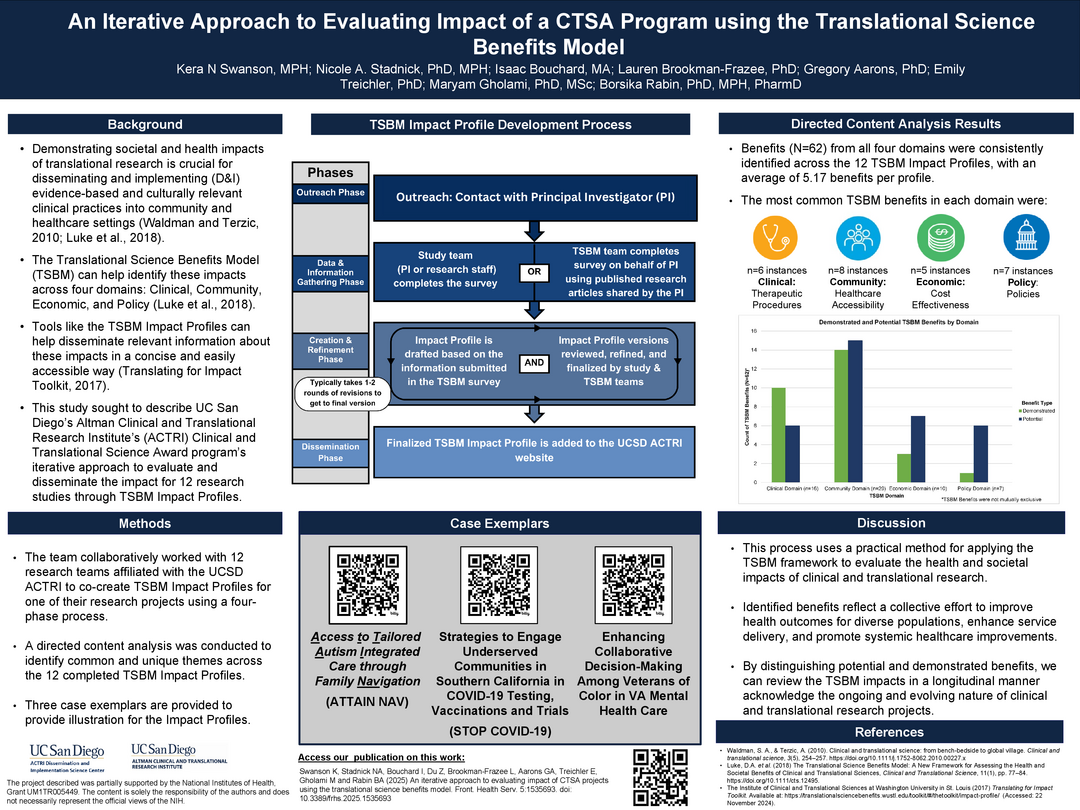
Background: Clinical and translational science streamlines the translation of research evidence into real-world practice, benefiting broader communities. Demonstrating the relevance and impact of this work across diverse settings is crucial for disseminating and implementing (D&I) high-quality and culturally relevant clinical practices. The Translational Science Benefits Model (TSBM) helps assess clinical and community health impacts of translational research outcomes beyond traditional measures. The University of California San Diego’s Altman Clinical and Translational Research Institute (UCSD ACTRI) adopted the TSBM to evaluate the impact of their supported research projects. This study describes an iterative approach to develop TSBM Impact Profiles and identify themes related to TSBM domains and key benefits.
Methods: UCSD ACTRI investigators completed an online form adapted from the TSBM Toolkit, detailing the project challenge, approach, intended impact, and relevant TSBM domains and benefits. The ACTRI TSBM team synthesized this information and aligned it with the TSBM framework. Finalized content was transformed into 1-3 page TSBM Impact Profiles published on the ACTRI website. A directed content analysis examined themes related to TSBM domains and benefits across the profiles.
Results: Results from three published D&I-specific Impact Profiles indicate TSBM benefits covered all four TSBM domains (Community, Clinical, Policy, and Economic), with a notable focus on community, clinical, and policy-related benefits. Each profile contained unique benefits (M=5) across these domains, including both potential (M=2) and demonstrated benefits (M=3). The ATTAIN NAV project highlighted Community, Clinical, and Policy benefits by improving engagement with health services and influencing healthcare policies. The STOP COVID-19 project addressed all four domains, enhancing healthcare practices for underserved communities. The Enhancing Collaborative Decision-Making project focused on Clinical, Community, and Policy benefits by engaging veterans of color to improve mental health care quality and utilization.
Discussion: This work provides practical methods and example case studies for applying the TSBM framework to evaluate the relevance and impact of research projects. Results highlight an effective process for capturing a multitude of impacts across diverse projects, reflecting core D&I objectives by assessing evidence-based interventions that address public health and healthcare disparities. Additional impact profile data will be presented to further demonstrate the applicability of this method.
Methods: UCSD ACTRI investigators completed an online form adapted from the TSBM Toolkit, detailing the project challenge, approach, intended impact, and relevant TSBM domains and benefits. The ACTRI TSBM team synthesized this information and aligned it with the TSBM framework. Finalized content was transformed into 1-3 page TSBM Impact Profiles published on the ACTRI website. A directed content analysis examined themes related to TSBM domains and benefits across the profiles.
Results: Results from three published D&I-specific Impact Profiles indicate TSBM benefits covered all four TSBM domains (Community, Clinical, Policy, and Economic), with a notable focus on community, clinical, and policy-related benefits. Each profile contained unique benefits (M=5) across these domains, including both potential (M=2) and demonstrated benefits (M=3). The ATTAIN NAV project highlighted Community, Clinical, and Policy benefits by improving engagement with health services and influencing healthcare policies. The STOP COVID-19 project addressed all four domains, enhancing healthcare practices for underserved communities. The Enhancing Collaborative Decision-Making project focused on Clinical, Community, and Policy benefits by engaging veterans of color to improve mental health care quality and utilization.
Discussion: This work provides practical methods and example case studies for applying the TSBM framework to evaluate the relevance and impact of research projects. Results highlight an effective process for capturing a multitude of impacts across diverse projects, reflecting core D&I objectives by assessing evidence-based interventions that address public health and healthcare disparities. Additional impact profile data will be presented to further demonstrate the applicability of this method.
Authors
First Author
Borsika Rabin , PhD, MPH, PharmD
Contributing Authors
Kera Swanson , MPH
Maryam Gholami, PhD
Nicole Stadnick, PhD, MPH
Isaac Bouchard, MA
Lauren Brookman-Frazee, PhD
Gregory Aarons, PhD
Emily Treichler, PhD
Tags
TSBM
dissemination
impact
Poster