Log in to view meeting materials such as meeting slides and recordings
2025 Fall CTSA Program Annual Meeting
2025 Fall CTSA Program
Annual Meeting
Artificial Intelligence in Last Mile Translation: Catalyzing Learning
Hub not available
Abstract
Advancing a New Paradigm for T4 AI Application
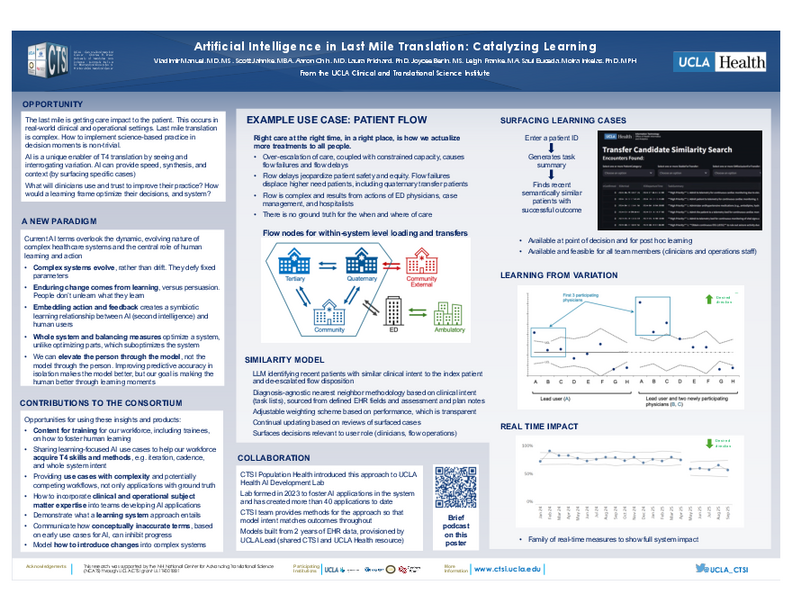
Background: Many AI applications in healthcare optimize narrow functions rather than whole systems. These products can be taxing to physicians and address a symptom rather than a cause of health system pain points. Also, translational researchers often seek to persuade clinicians to trust AI predictions rather than use AI to enhance human performance, which is true clinical decision support and a unique contribution of AI. The CTSI hub collaborated with the UCLA Health AI Development Lab to address these issues
Methods/Innovation: The Lab leverages UCLA Health analytics and operations, and multiple hub programs, to form teams of clinical informaticists, computer scientists, translational researchers, and health system operational leads who scope the problem and iterate toward a durable solution. The teams seek system-level problem solving—creating conditions for durable change. Most recently, the Lab is advancing a new paradigm for T4 applications of AI by: (1) orienting teams on optimizing a system rather than its isolated parts, (2) focusing on making humans better through learning, rather than making models better; (3) embedding iterative improvement frameworks into AI projects; and (4) incorporating feedback loops that reflect the variation and evolution of healthcare systems, i.e. the lack of ground truth in problems such as providing the right care in the right place. This has produced an interactive platform that applies nearest-neighbor methods to surface clinically relevant cases for physicians. This accelerates their learning and improves future decision-making about patient placement and treatment.
Impact: The CTSI collaboration with the AI Development Lab is a translational science innovation that enables more durable translation of knowledge into practice. The new paradigm fosters a new culture of AI for translation: clinicians, informaticists, and translational researchers work side by side, using shared language and continuous feedback to accelerate knowledge into practice. It is highly adaptable for dissemination across the national CTSA consortium, with an open and modular informatics platform integrable into many electronic health record environments; scalable statistical and data-driven methods (e.g., nearest-neighbor case surfacing) that can be applied within and across clinical domains; a shared evaluation and feedback framework that supports the real-time needs of delivery systems; and a collaborative action model that fosters a shared learning culture of frontline clinicians, operations, health system informatics, and scientists. The collaboration is a practical, reproducible blueprint for other CTSA hubs seeking to expand translational science capacity through AI-driven, data-enabled infrastructure.
Background: Many AI applications in healthcare optimize narrow functions rather than whole systems. These products can be taxing to physicians and address a symptom rather than a cause of health system pain points. Also, translational researchers often seek to persuade clinicians to trust AI predictions rather than use AI to enhance human performance, which is true clinical decision support and a unique contribution of AI. The CTSI hub collaborated with the UCLA Health AI Development Lab to address these issues
Methods/Innovation: The Lab leverages UCLA Health analytics and operations, and multiple hub programs, to form teams of clinical informaticists, computer scientists, translational researchers, and health system operational leads who scope the problem and iterate toward a durable solution. The teams seek system-level problem solving—creating conditions for durable change. Most recently, the Lab is advancing a new paradigm for T4 applications of AI by: (1) orienting teams on optimizing a system rather than its isolated parts, (2) focusing on making humans better through learning, rather than making models better; (3) embedding iterative improvement frameworks into AI projects; and (4) incorporating feedback loops that reflect the variation and evolution of healthcare systems, i.e. the lack of ground truth in problems such as providing the right care in the right place. This has produced an interactive platform that applies nearest-neighbor methods to surface clinically relevant cases for physicians. This accelerates their learning and improves future decision-making about patient placement and treatment.
Impact: The CTSI collaboration with the AI Development Lab is a translational science innovation that enables more durable translation of knowledge into practice. The new paradigm fosters a new culture of AI for translation: clinicians, informaticists, and translational researchers work side by side, using shared language and continuous feedback to accelerate knowledge into practice. It is highly adaptable for dissemination across the national CTSA consortium, with an open and modular informatics platform integrable into many electronic health record environments; scalable statistical and data-driven methods (e.g., nearest-neighbor case surfacing) that can be applied within and across clinical domains; a shared evaluation and feedback framework that supports the real-time needs of delivery systems; and a collaborative action model that fosters a shared learning culture of frontline clinicians, operations, health system informatics, and scientists. The collaboration is a practical, reproducible blueprint for other CTSA hubs seeking to expand translational science capacity through AI-driven, data-enabled infrastructure.
Authors
First Author
Vladimir Manual, MD, MS
Contributing Authors
Scott Jahnke, MBA
Aaron Chin, MD
Laura Prichard, PhD
Joyce Berin, MS
Leigh Franke, MA
Saul Euceda, Clinical Informatics Specialist
Moira Inkelas, PhD, MPH
Poster